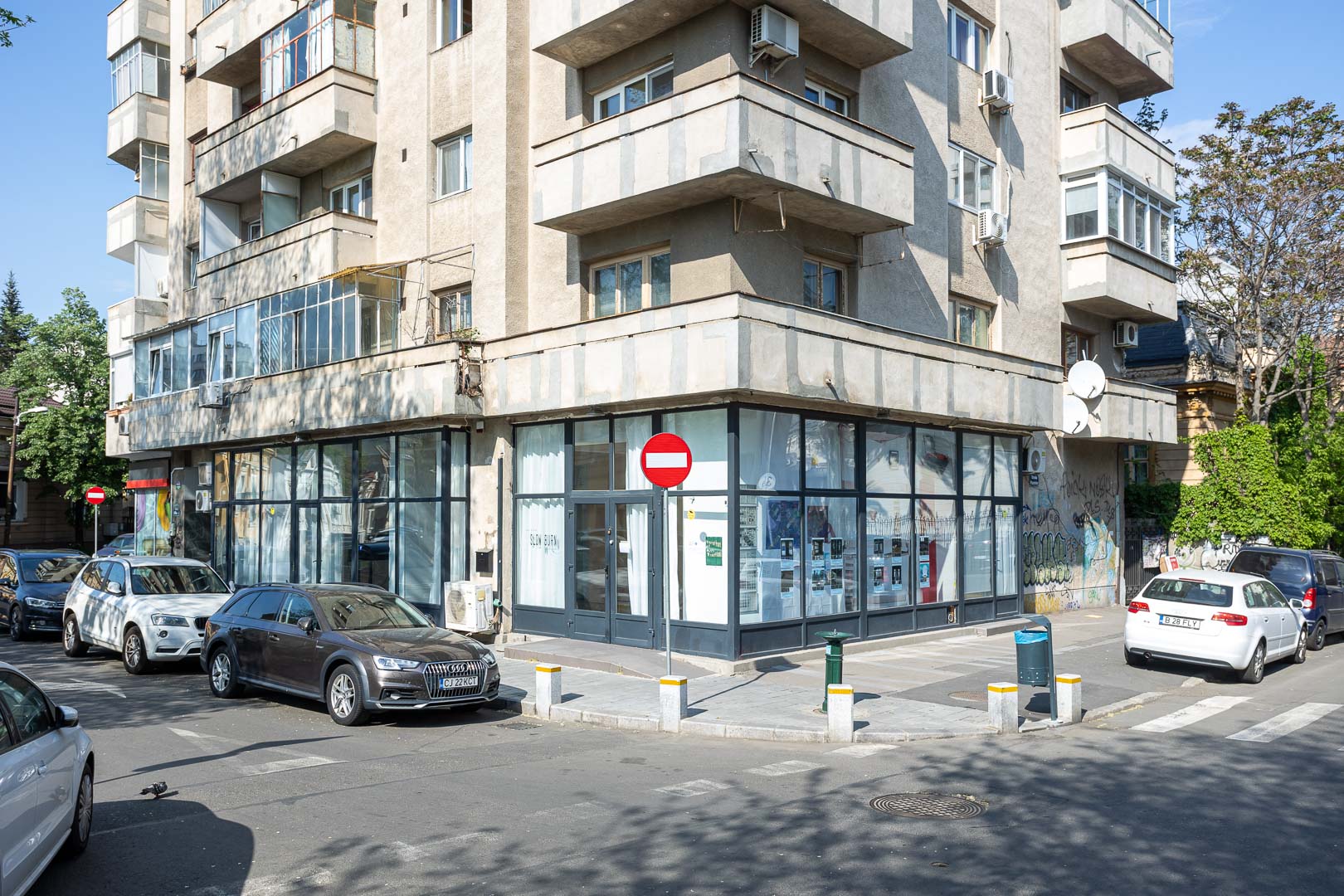
The building in which the Suprainfinit gallery is located, at 22 Mantuleasa, has a scarcely documented past. In 1929 there was another building with a similar configuration, which was destroyed in the 1977 earthquake. Only the footprint of the building remained, on which the current block was built during the socialist period. On the ground floor, where the gallery is now located, there used to be a grocery store, a grocer's shop and a bar. After renting the space, Suzana Vasilescu (founder of Suprainfinit Gallery) kept only the ceiling and the terrazzo floor in their original configuration.
Today, half the block is vacant because most of the owners live abroad and "don't want to rent because they don't need the money," Cristina says. "I think there are a lot of situations like that in the neighborhood, where houses have been passed down from generation to generation."
Before working with the gallery, Cristina lived in London but she visited Bucharest often. During one of her visits, she saw Suprainfinit's (pre)(history) group exhibition and afterwards got a job there. Since then, she has lived in the Mantuleasa neighborhood and has made the same walk from home to the gallery for five and a half years.
Maria grew up in Mantuleasa, on the corner of Calea Mosilor and Obor. She still lives in the area and, like Cristina, feels that she lives in a "15-minute city". Which reminds me of urban planner Mikael Colville-Andersen, who said in an interview: "We should think of the city and the neighborhood as a place where we have everything we need within a 15-minute walk. That's the way the world's cities have been for 7,000 years, and that's what we should relate to."
Part of the street Cristina and Maria walk from their home to the gallery was, in the 19th century, the link between Pontul Targului de Afara, now Calea Mosilor, and Ulita Vergu, now Calea Calarasilor, Bucharest's main commercial streets. Today, Mantuleasa Street has a slightly different character - it maintains its status as a link between two main arteries for motorists, but is also part of a pedestrian route for the city's inhabitants.
The present neighborhood, formerly Mahalaua Mantuleasa, dates back to the second half of the 18th century. The name comes from the Manta family, specifically from the merchant Matei Manta and his wife Stanca, also called Mantuleasa. After the death of her husband, Mrs. Manta built a church in post-Brancovenesc style, right in front of her house, next to where the gallery is today. The church survived intact and is now listed as a historical monument.
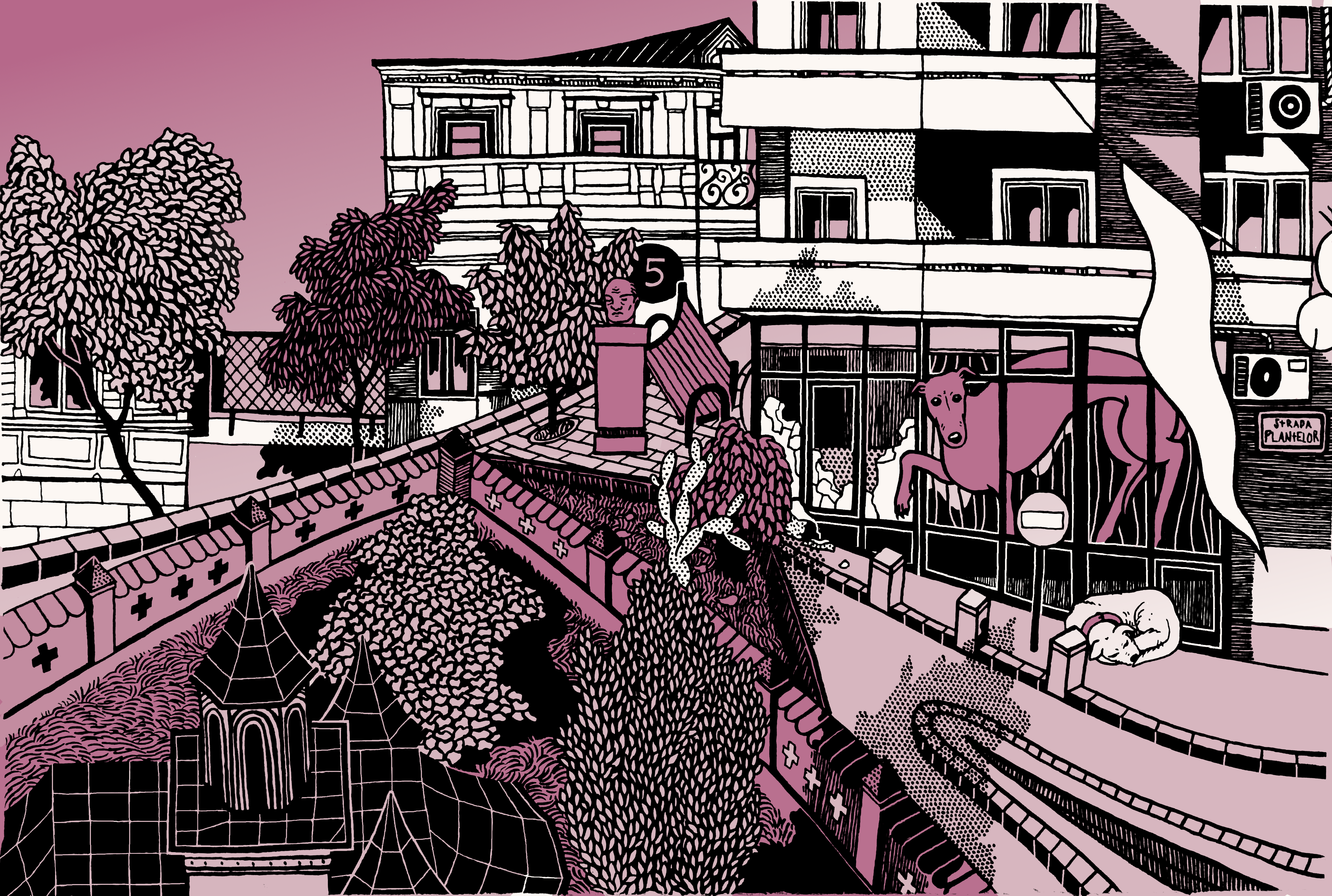
The square in front of the gallery is a crossroads at the intersection of five streets: Mantuleasa, Plantelor, Pictor Stefan Luchian, Pictor Alexandro Romano and Negustori. The square created by the intersection of these streets was built in 1871, together with the plans for the alignment of the streets. The same streets that now bridge the access to the Suprainfinit gallery form a kind of neighbourhood district where you can find a Mega Image Shop & Go, a 5 To Go cafe, a B & B hotel. In its center you can find a small asphalted island that has been transformed into a tiny park frequented by the neighbors every evening, especially in the summer. All around there is the constant hum of traffic. The louder traffic noises remind you that the hum of traffic never ends here, you just get used to it.
Also on this island you can find the bust of the writer Mircea Eliade, who attended the school (now demolished) on Mantuleasa Street between 1914 and 1917. The City Hall considered it important not to forget the face of the famous writer who lived in the neighborhood, and adorned the square with a monument by Vasile Gorduz.
The small square draws attention to the potential of such a "marginal, forgotten, abandoned, but also ecologically interesting place," explains Maria, in the context of the Suprainfinit Collisions. A day-long marathon of performances, screenings, live concerts and a reading in the square in front of the gallery, where several guests read texts written on the subject of "ecological futures."
Next to the square in front of the gallery a fenced patch of grass surrounds the wooden cross erected by the Mantuleasa church. In 2020, Ziad Antar, an artist from Beirut, installed a sculpture of a cactus made of cement and resin, from which a petal later disappeared. Cristina says that someone took it and, when they realized they couldn't do anything with it, left it next to the sculpture. Ironically, in prehistoric times, cactuses were used as natural agricultural fences to protect against animals and as barricades to mark private property.
"If we were in London, this kind of space would have no doubt been capitalized. And I said, okay, let's capitalize it artistically as well," says Cristina, explaining her decision to use the showcase as an exhibition space. "Designing installations for a showcase can feel restrictive, yet they also afford you with a very unique creative freedom because of the confined space." We're talking about a space that's 5 meters long and 40 to 45 centimeters wide, a space where you wouldn't have room to turn around.
This narrow space, which gets very hot in the summer, hasn't always functioned independently of the gallery's main space: "It took me a couple of years to give the showcase total independence and say, 'OK, while there's an exhibition in the main space, we can have something completely different in the showcase." Cristina realizes that the way the showcase gained its autonomy was actually paradoxical: it happened when she stopped presenting it to the artists she worked with, stopped problematizing it, and stopped presenting it as an option for projects exhibited in the main space - "When you stop talking about an object, it becomes independent. You give it an invisibility and it actually becomes visible. It is a living space, but also a latent space. It has its own rhythm: sometimes dormant, sometimes erupting."
Some artists have proposed works that step out of the shop window and into the street. Take Vlad Brateanu's Work Done, a site-specific installation that raises the question: when is a work really done? The word "WORK", painted in gray, tracks the concrete patches on the balconies of the block where the gallery is located. The word "DONE", also painted in gray, can still be read on the asphalt.
In another project, Cristina asked her neighbors for permission to hang waterproof canvases (4 meters x 2 meters) painted by artist Rebekka Ana Aimee Stuhlemer on their balconies. "We put them on the bed and breakfast across the street, on the 'Count's' house next door, who has a beautiful 19th century house, and on the balcony above the gallery," she says. "We also wanted to hang one from the 5th floor, but one of our neighbors wouldn't let us, who, as a former pilot, is afraid of heights," jokes Cristina.
At some point, Cristina felt it was time to pass the baton and invited young curators to experiment with the space. Two of the projects were conceived under the umbrella of the Specula collective (a speculative writing platform) and were specifically related to the history of the neighborhood. Both of them have been very well received in the article "Legends, magic substances and dogs on Mantuleasa". In Sequence #14: Of Canines and Concrete, the research project that brought together Maria, Irina-Anca Bobei and Mircea Andrei Florea, a multimedia installation tells the canine-human history of Bucharest, which inevitably brings into discussion the euthanasia of dogs in the 2000s. Their idea stems from a legend in Mantuleasa, according to which the wicker fence that surrounded the Manta family's orchard in the 18th century was removed over time by passersby who used it to fend off neighborhood dogs.
The Dogs and Concrete project was, appropriately enough, a dog-friendly event. They bought food for dogs roaming the area, for visiting dogs, or for Puiu, the neighborhood's patruped. "He's kind of the Count's dog, but not really. He also hangs out in the street, he's a free-roaming dog," says Cristina. Also in the showcase a video showed Puiu entering the gallery and interacting with the space and the people. Cristina says that Puiu comes to almost every opening, but she remembers that he was absent the night before. Maria adds, "And he wasn't at the dog opening either."
"What I found interesting about the eyes of the dog statuettes I found on the Internet is that sometimes the statuettes were identical, but people painted the eyes differently," explains Maria, placing on the table one of the ceramic puppies displayed in the window. An element of material culture that doubles the historical information with a personal touch.
Their research also included a small "community" intervention in the Crucea park, where they left hygiene bags for the puppies, which, unlike the cactus petals, were successfully used.
Another showcase intervention, Sideseeing DIY, also by Specula, started from the urban folklore of Mantuleasa. Artists and performers Daniela Custrin, Andra-Bianca Coman and Matei Dumitriu dug up conspiratorial horror stories that revealed the marks of a magical collective imaginary of the neighborhood. Some were found on the Internet, others emerged from conversations with people. The result was a cabinet of curiosities in which they exhibited bottles containing all sorts of colored liquids, stones, or photographs, which were inscribed on the border between alchemy and rewritten history.
The events designed for the showcase trigger a very different and genuine interaction with people in the neighborhood. Cristina recalls that during one of Alina Usurelu's performances about exhaustion, she had a very honest dialogue with a neighborhood kid. "It was a neighborhood child who didn't understand the movements. She had a plastic wrap around her body and very long dreads. The child was fascinated and asked, 'What is she doing? Why is she doing it? What does it mean?'. I said, 'well, look, it's about exhaustion. Uh, I mean, she works a lot.' Then he asked me, 'Are you paying her? Do you pay her for this?'. There weren't many people at the time, but for me that interaction with the kid in the neighborhood was 'Wow!' He called his brother and he came. I invited them to see the exhibition."
I wanted to better understand the nature of the showcase, what such a space is and how it differs from others - from a street, a domestic space, a shop, a shop window, etc. At the inevitable risk of over-interpretation, I came to the Suprainfinit meeting with two conceptual propositions: heterotopia (M. Foucault, "Other Spaces") si porous space (W. Benjamin, "Naples"). I had the impression that the window had a little of both.
It seems to be an indecisive place, where inside and outside are juxtaposed, where the space turns its back on the gallery and looks exclusively towards the street. Despite its location, the showcase seems to be outside the gallery and, if we may say so, inside the street. Although it is usually the passer-by who looks, in the case of the showcase there is a also a gazing back, as Cristina and Maria put it. The showcase thus has something of a mirror, a space that Foucault placed midway between utopia (non-place) and heterotopia (different place). Another "superpower" of heterotopias, especially present in theater and cinema, is that of attacking the everyday's claim to reality. In this exchange of glances between the projects housed in the shop window and the street, what is at stake is the very locus of reality, or rather its loci. In other words, the shop window can distance me from what I have considered to be "as real as possible."
In fact, it also produces this type of disruptive effect when it comes to the logic of consumption and advertising. What happens around the showcase does not invite consumption and does not refer to any merchandise; one's expectation is subverted. Separated from the main space of the gallery by an opaque wall, the showcase allows for an equal and completely free interaction in every sense of the word. Anyone passing in front of it can exchange glances with what is on display, without having to commit to entering the main gallery space. "People stop, they look, they understand, or they don't understand, and that's cool. Who understands contemporary art? And you don't even have to understand it. It's cool that you just stop," says Cristina. Maria thinks that "the showcase is a more intimate space [than the main gallery space], even though it's on the street. Perhaps intimacy cannot be realized in the absence of gratuity.
Unfortunately, in the Romanian language, the synonyms for the word "gratuitous" refer to an absence or lack - what is gratuitous is useless, inefficient, futile, etc. The Ancients, on the other hand, believed that uselessness, and by implication gratuitousness, should be associated with freedom. When I do something for its own sake and not for any gain, when I spin around in the pleasant circularity of a particular state or activity, something unique to my existence happens: freedom arises. It is as if, by lingering within the radius of attraction of a body that I love, I am paradoxically freed from gravity.
I said above that the narrow showcase at Suprainfinit is also a porous space. The law of porosity to which I refer, following W. Benjamin, is improvisation, ephemerality. What is porous refuses the "stamp of the definitive" and always leaves room for various reconfigurations. The showcase is porous because its open character allows it to be surrounded by passers-by, artists, and the gallery's regular public. It would be worth asking what other public or private-public spaces in Bucharest allow for such (re)configurations. Around the shop window, under its pretext, discussions and free encounters often take place. These "unpredictable constellations" of interactions between passers-by and the artists involved can occur all the more when the display window hosts artistic projects that literally go out into the street, shifting the boundary between public and private.
By February 2023, the gallery also had a second exhibition space, almost the entire side facing the small plaza. This buffer space was created when a dry wall that connected the three linearly arranged resistance pillars inside the gallery was erected. After a collaboration with Swedish artist Nilz Kallgren, the connecting wall was torn down, opening the main gallery space to the outside. "I want the central sculpture in my exhibition to be the demolition of that wall," Cristina recalls Nilz's surprising proposal. "His whole exhibition was about what it means to withdraw. (...) He made the comparison of peeling off the skins of the space. They are the pillars of the building and they are massive. Then there was the plumbing, the wiring, the electricity, the water. For his show, we left all that part visible, he didn't want us to do anything, and neither did I. It opened up the space a lot. It forces you to find other ways of installing work and looking at the space," she adds.
Nilz Kallgren participated in the destruction of the drywall along with a handyman. "It was destroyed quicker than I thought. It took several hours. The moment was very powerful and very simple", says Cristina. The action took place without an audience because Nilz wanted the gesture to remain sculptural and not be mistaken for a performance, Maria says.
The demolition of the wall and the disappearance of the display case have significantly changed the interaction between the gallery and passersby, as Maria told us: "Since the wall is gone, there are a lot more people who, when I'm outside the gallery for a cigarette, for example, without entering the gallery, come up to me and tell me that they saw work X when they passed by a few days ago and that they have an opinion about it." One night, as Cristina was setting up a new exhibition, a woman stopped by to tell her, excitedly, that she really liked what was coming up. Another lady from the neighborhood came to the gallery to inquire about the work of artist Hadassah Emmerich. She had really liked it and didn't understand why they were no longer on display.
Beyond the accelerated interaction with passersby, Nilz Kallgreen's "gomage" at Suprainfinit Gallery highlighted another aspect: vulnerability. "There are days when I feel very watched when I'm doing something in the main space," says Maria, and Cristina recalls one artist's project to maximize that visibility, moving his office from the back of the gallery to the main space. "The challenge is how far you can take it, how much you can test this porous, liminal space and so on." I've been thinking about how much the game of the gaze says about a city and its life. In Bucharest, this game is still haunted by mistrust, it's uncomfortable and stingy. It seems that there is still a habit in the air to relate to the other non-horizontally, indirectly, through a third (big brother) - a quasi-judging and moralizing instance.
I imagined the moment when the drywall came down as if I were there. It is clear that one of the tendencies of today's world is to limit and demarcate, to expand, to build, to enclose between borders and to promise security. Just think of the way some residential neighborhoods, "enclave spaces" in the terminology of the Greek architect and activist Stavros Stavrides (S. Stavrides, The Common Space) - barriers, charters, cameras, their own rules of operation. If we look at things from a spatial point of view, the gestures proposed by Nilz Kallgren, to retreat and to tear down, stand in opposition to such tendencies and perhaps more in balance with the generalized rush for the private.
Speaking of the interplay between what you control and what you let be, since the wall came down, the gallery is constantly flooded with natural light, sometimes very bright, sometimes mottled. As a result, the space is far from the classic white cube, hermetically sealed, brightly lit in a controlled way. As a result, video works are not exhibited very often, but rather installations and sculptures. But, Cristina adds, the gallery's main space remains a white cube that changes with each exhibition. And light is not only about constraints, but also about creating magical moments - the sunset being one of them.
Towards the end, I asked Cristina and Maria about the relationship between Suprainfinit and other galleries in the area - Anca Poterasu Gallery and, until recently, GAEP. This led to the Doi Joi project, a collaborative program launched in 2021, in which several exhibition spaces extend their opening hours on the second Thursday of every month and host synchronized special events. "Doi Joi goes really well. Just yesterday, people came to the opening that I've never seen before. There's also Atelier 35 in the area, we're kind of close, not as close as the others, but it's on the circuit here. And the Posibila gallery. It's just really hard to synchronize all the time. At a certain point it just worked. About 3-4 years ago we all managed to open - us, GAEP and Anca Poterasu. We made stencils on the floor, it was nice".
We ended the discussion by talking about the general atmosphere of the Mantuleasa - Plantelor area. The neighborhood is residential, quiet, "still not the creative neighborhood," laughs Cristina. We say goodbye outside, in front of a kiosk recently installed by the town hall. The neighborhood dog, Puiu, doesn't show up, so we take another look at the shop window and walk down Mantuleasa.