In a marketplace, paper doesn't have a grand destiny. It wipes the juices from fruits and vegetables, wraps meats and sausages, or is the receipt that you crumple the moment it reaches your hand. In an environment dominated by humidity, heat and smoke, noise and agitation, you'd be surprised to find a bookstore.
And yet, if you walk into the old Obor Halls building, make your way through the multitude of stalls and climb the metal staircase to the first floor, then go past the barber's and the agricultural shop and out onto the terrace, you'll come across the Paper Traffic bookstore.
At least that's what Vlad Mihai, the founder of the publishing house, told us. We wanted to see it with our own eyes, and, why not, also do some shopping, so we took the No. 10 tram towards Obor on a Saturday morning.
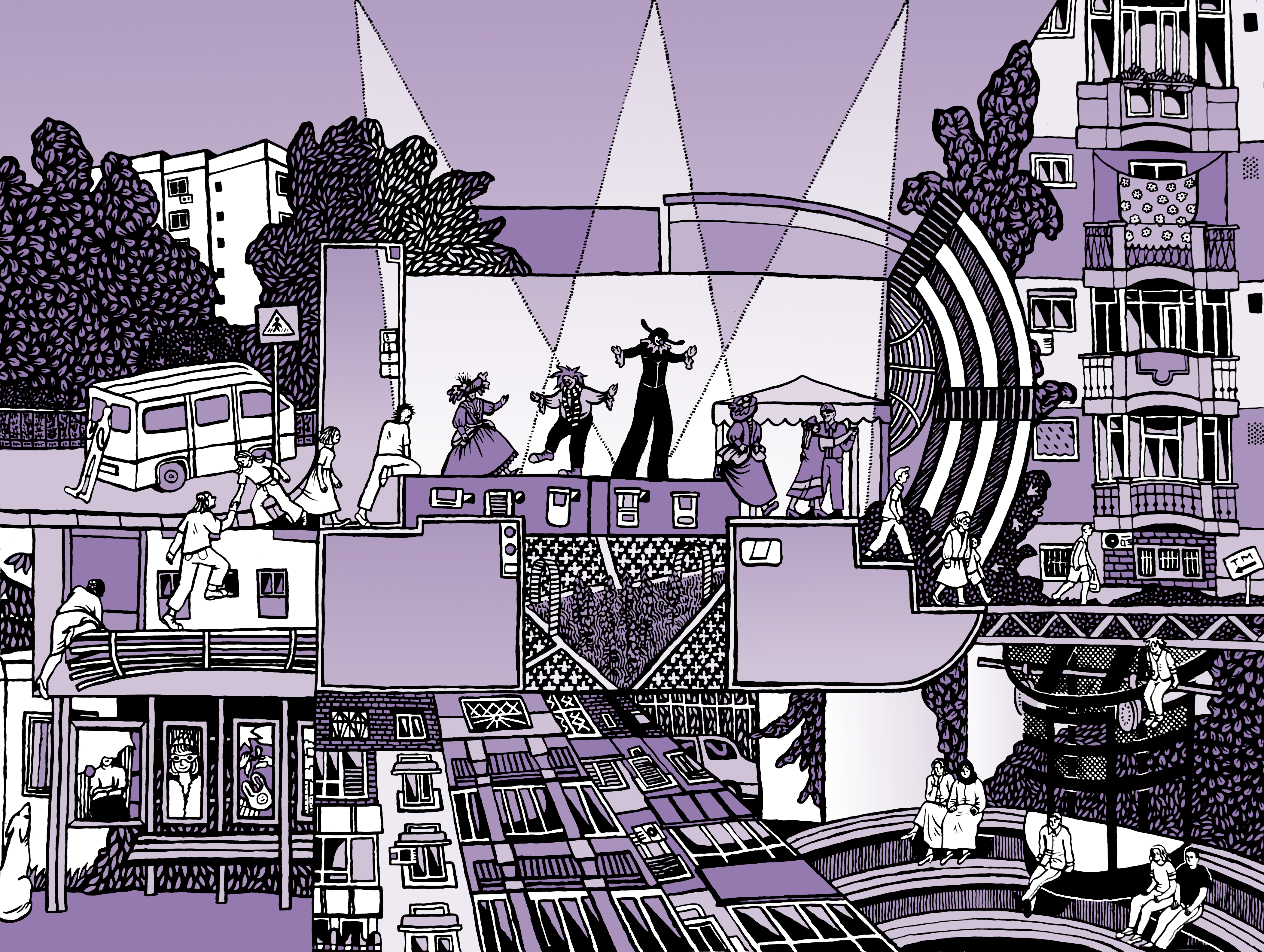
Already after Iancului, the tram starts to get noticeably crowded. Most of the people getting on are pensioners dragging folded shopping trolleys lined with bags. As we approach the Obor station, the atmosphere gets tense and the first conflicts break out: people accuse each other of not moving fast enough towards the doors, or of getting in the way. When the tram stops at the station, silence sets in for a few seconds. Then the doors open and people rush out, unfolding their trolleys over our heads. When the plastic wheels hit the asphalt, a buzz envelops us.
We walk towards Obor in a compact group, at a pace bordering on a jog, which, if seen from above, would probably resemble the V-shaped formations of migrating birds. When we get close to the entrance to the market, we exit the formation to wait for Maria, who is doing the illustrations for the article. We meet in front of a landmark chosen on the spot, "next to the beer and small terrace, with Neumarkt written all over it, it's green". In the meantime, our group was absorbed without a trace in the bustle of the market.
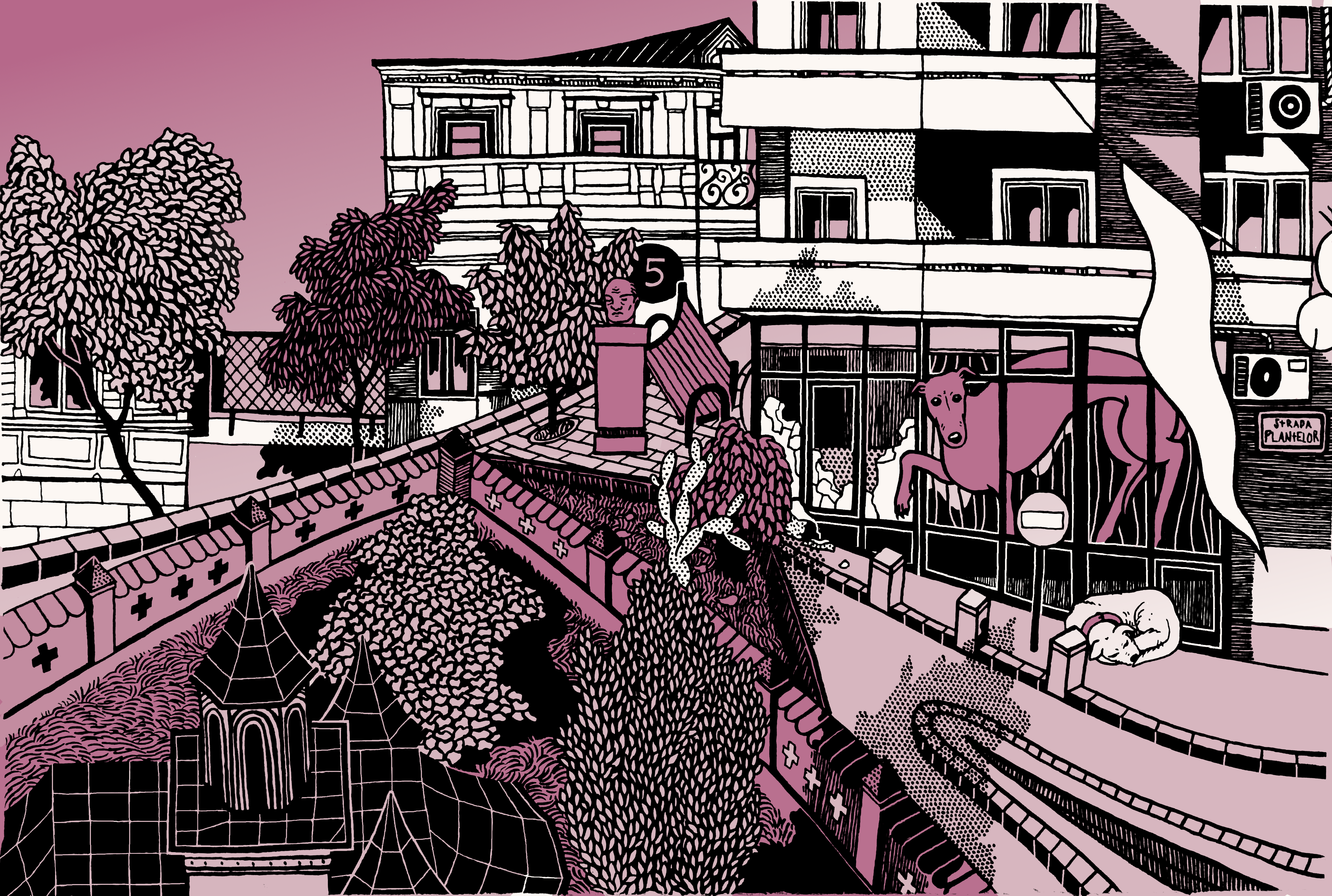
The Obor marketplace has survived, in various forms, for more than 300 years. In other words, in the Obor market, people paid with both gold coins and contactless with the phone. When you look into this abyss of time and lives, your mind starts to whirl. But unlike other places with a long history, there's something atypical about Obor. Surrounded by its enveloping agitation, it's hard to put your finger on what has endured for so long. Everything here is in transition, from fresh to spoiled, from raw to cooked, from one hand to another. Nothing seems to stand still and you feel that every moment of rest is charged with the tension of the next movement. So what, exactly, has endured for over 300 years here, where everything is so changeable?
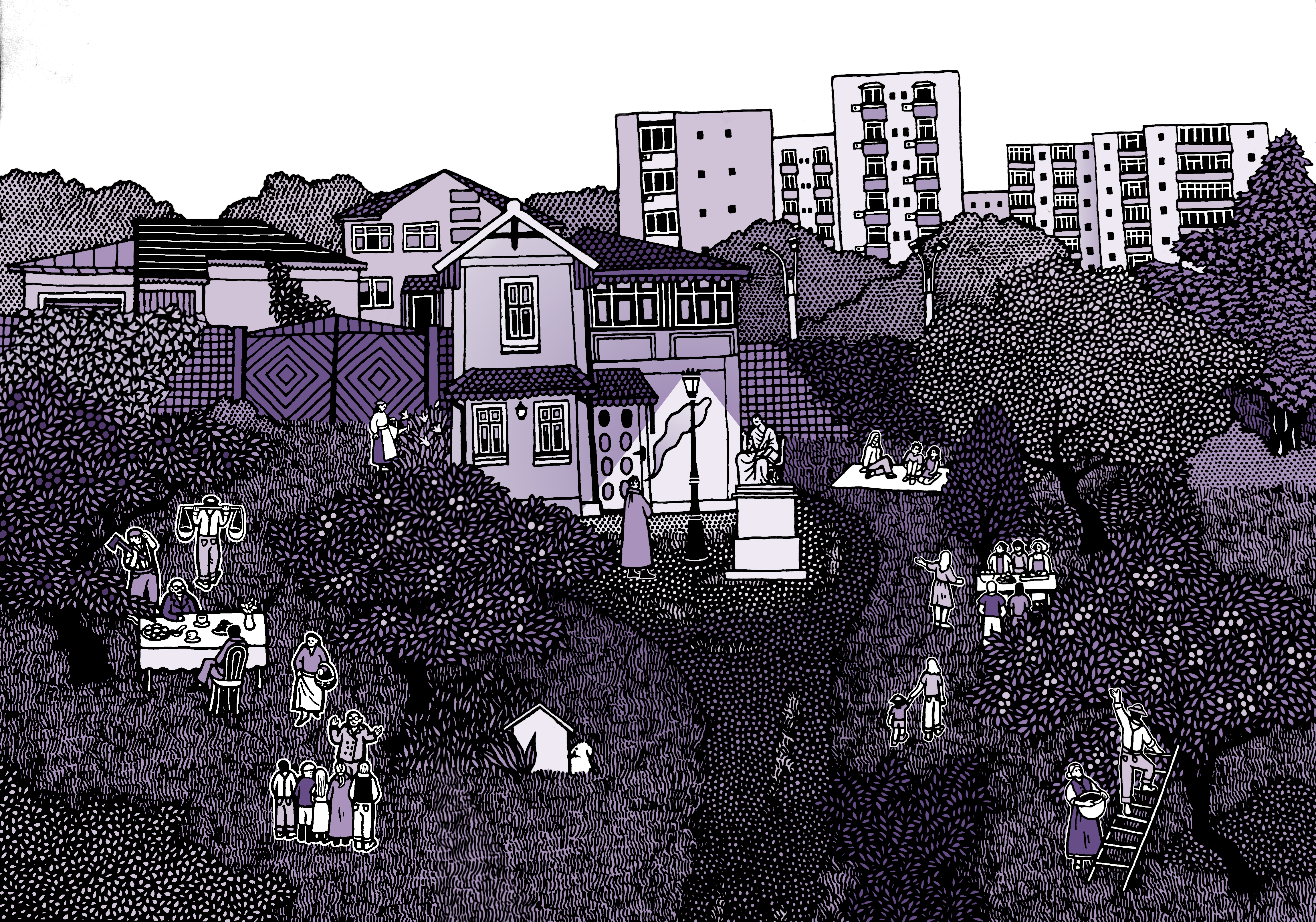
The history of Obor only deepens this question. Established in the 17th century, Obor was at first a cattle market. As the slaughter of animals raised public health concerns, the fair was moved to the outskirts of the city. Besides animals, until 1823, on the streets of Obor also trudged the condemned to the gallows: bandits, traitors and conspirators. There was even a tradition according to which the people in the square would offer wine to the condemned on their way to the gallows to raise their spirits. Of this, all that remains is the stone cross you can see in front of the town hall. It was erected by merchants towards the end of the 19th century to consecrate the place tainted by the executions. Then followed a more festive period in Obor`s history, when it hosted the Mosilor Fair, which attracted crowds with the promise of cheap entertainment: food, drink, music, the traditional braga and sweets or circus and magic shows.
As a journalist from the interwar period nostalgically observed, the popularity of the fair had almost completely faded when, in 1936, the construction of the Obor Hall began under the direction of architects Horia Creangă and Haralamb Georgescu, which was not completed until 1950. In 2007, the old square was demolished and the new Obor Halls were built in its place.
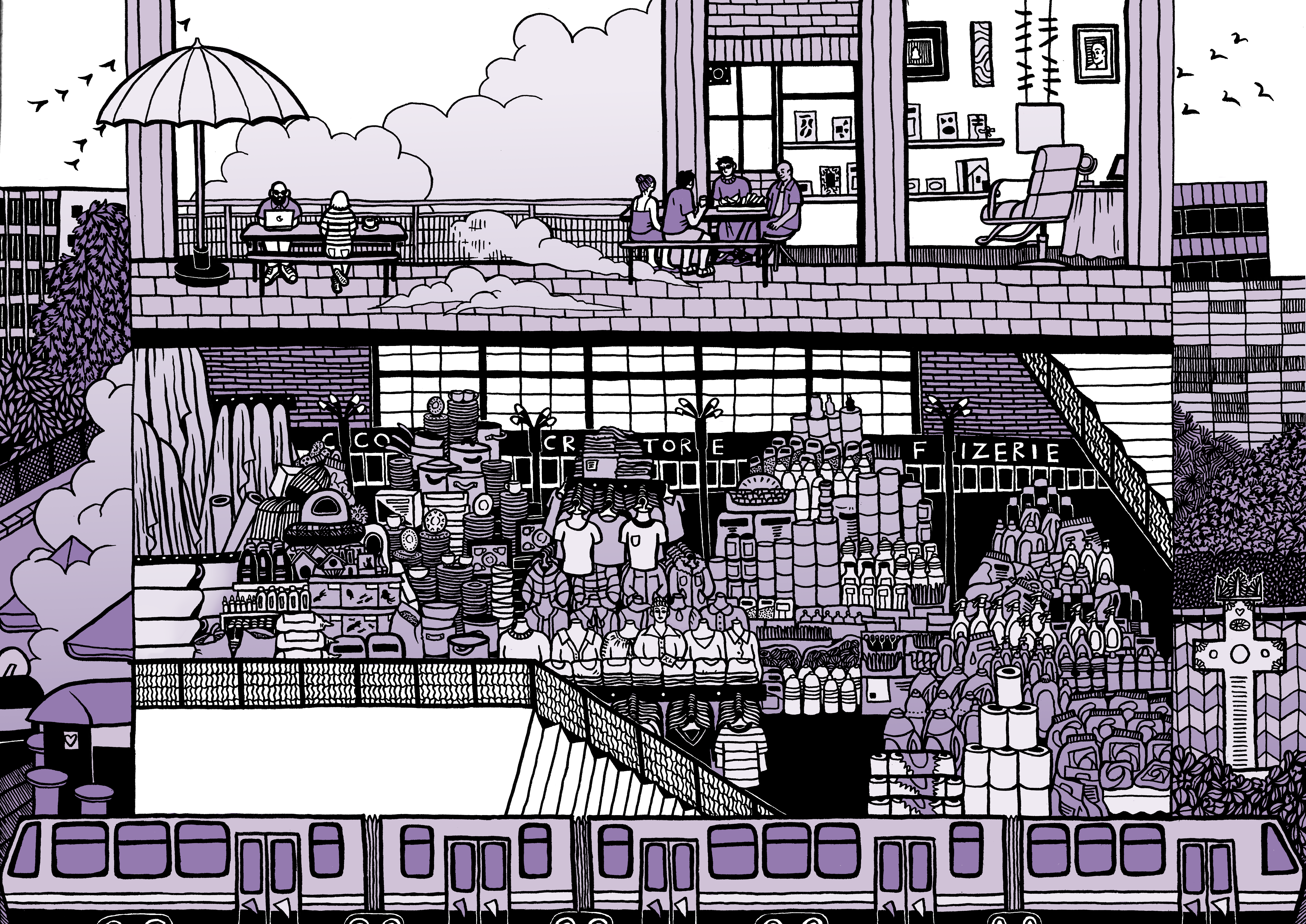
We spot Maria, finish our coffees, and make our way to the Paper Traffic bookstore through the old Obor Hall. As soon as you enter, you're struck by the diversity of objects and colors. First you come across stalls with all kinds of screws and pipes, electrical appliances or gardening tools, and piles of kitchen utensils designed for the most specific of needs. As you advance, you'll also find pyramids of mustard jars and canned peas or beans, and even a large ziggurat made from household cleaning products.
Further toward the center of the hall is an area dedicated to clothes and fabrics. Here, the stalls lose their geometric configuration in favor of a sinuous one. At one of the stalls, drab puffer jackets hang three feet above your head, their sleeves tucked deep into their pockets, simulating the cold wait at a tram station. And from below, from behind a couple dozen hangers, the dark feminine eyes of the only mannequin with a head stares down at you from the middle of a group dressed in summer shirts. She looks like their leader.
At the end of the hall are stalls selling bulk candy and all kinds of sweets, seeds and nuts, and, since recently, two Asian spice shops, where long queues of Indians, Nepalese and Pakistanis usually form. Next to them, but much less popular, you find a traditional cheese shop with old glass display cases and white-tiled walls, where women in white coats serve.
We force ourselves to pull away from the strange attraction that all these objects have on us, and climb the metal staircase to the first floor. Seen from above, the colorful variety of the items for sale fades and converges to a shimmering silver, and the hall takes on an unexpected visual order. We snap a few photos and move on.
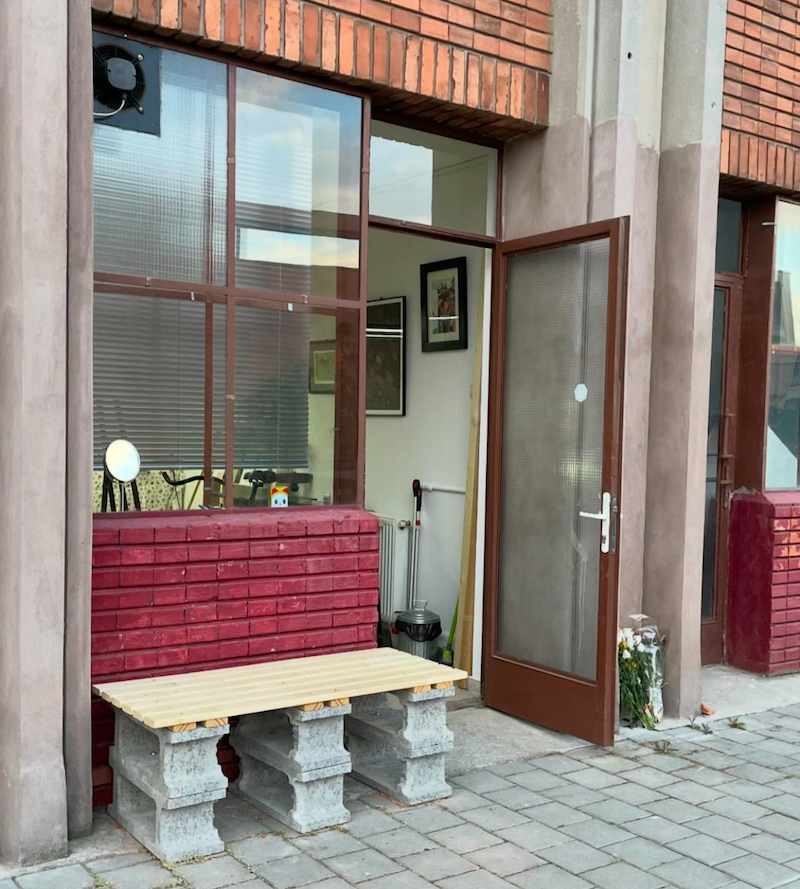
Vlad's bookstore is the first on the right as you come out onto the terrace. When we enter the 5-by-5-meter room of the bookstore, Vlad is with his back turned to the door and he's unpacking some bags in which I glimpse some tomatoes and cheese.
The diversity that you find inside the small Paper Traffic bookstore echoes, in its own way, the variety of Obor. Alongside elegantly designed volumes, you'll find second-hand books, water guns, a backgammon set, paintings — and even a fully equipped barber's chair.
While Vlad puts together an old-school platter — tomatoes, cheese, and onions sourced from his trusted suppliers — I ask him about two paintings that caught my eye. The first depicts a serene scene, in soft pastel tones: a few birch trees in what seems to be an urban park. The second shows Mike "I will eat your kids" Tyson mid-swing, throwing one of the brutal hooks that earned him the nickname "The baddest man on the planet." What strikes me is that both Iron Mike and the birch trees are painted in the same pastel, dreamlike style — a style that creates the effect of a nostalgic suspension in time. It's as if the painter wanted to insist that the two realities belong to the same world. I ask Vlad whether they're both by the same artist, and he says yes — it's a painter from Moldova who works as a prison officer by day and paints feverishly in his spare time. He's one of the artists Vlad has been working with for several years now, and whose paintings he frequently exhibits in the bookstore.
We sit down with Vlad at the little table in front of the bookstore, gathered around an impressive platter, and the first thing we ask about is the barber's chair. It all started ten years ago, he tells us, when he began practicing on some friends he was living with in Sălăjan. Little by little, he started cutting the hair of friends of friends, until, during the pandemic, he was biking around the city to give haircuts to their grandparents and grandkids too. "At one point, after I moved into my own place, I had a room that was just a barbershop — the entire room. Couch, waiting area, everything. I was giving 3–4 haircuts a day, and on weekends 10–12. The idea was to get the barbershop out of the house because, like I told you, there was hair under my pillow, hair in the fridge."
He tells us he rented the bookstore space three years ago, with the intention for the bookstore to be "the main boat," while the barbershop would serve as one of the "fishing rods." Now, it's the rod that ends up paying the rent: "A book might sell once every two months, but haircuts happen every weekend," he says. Clients book their appointments through Instagram and come in for cuts on Saturdays. Two of them are scheduled for this afternoon, in fact.
Vlad tells us that one of the reasons he opened the Paper Traffic bookstore was to bring paper-based art closer to people and to normalize their relationship with books. "First of all, I'm trying to defuse all this fog surrounding books — this nobility attached to the object of the book." He believes you should reach for a book the way you'd reach for your phone or laptop. That people should develop the habit of asking something from it — of expecting it to change them in some way. This approach also guides the editorial concept behind the books Vlad publishes. They have an intriguing appearance, inviting you to interact with the book even at the purely physical level, sometimes out of nothing more than tactile curiosity: "I try to make well-tailored books, easy to navigate, that whisper something to you before you even start reading," as Vlad put it in another interview, which you can find here.
Photo books, books of prose or poetry, and hybrid works that combine text and photography — like Arsenal 01, LAVA or Sentimatal 76 — all of which you can find on the shelves of Paper Traffic, share a strong visual concept at their core. Vlad tells us that behind the design and content of each book is a constant back-and-forth with the author, a collaborative effort to understand the book's direction. He tells us about a short story collection he worked on for almost a year and a half, trying to grasp its core: "I noticed that in every story, the character's emotional center is located in the throat. The expressions they use to describe their feelings are all related to the throat. They don't say, 'I was afraid,' they say, 'the root of my tongue dried up,' or 'there was a lump in his throat,' or 'the roof of my mouth collapsed.' That's why I called it The Globus Effect, after the globus sensation — which means a lump in the throat. I punched a hole through the book and bound it with thread. Basically, you have to untie the knot in its throat to be able to read it."
"Closeness" seems to be the word that best captures Vlad's editorial approach. It defines both the relationship between editor and author — which makes the collaborative creative process possible — and the relationship between books and readers. These books "descend" to meet people halfway, stepping out of the traditional spaces reserved for culture and into unconventional ones — like this bookstore–barbershop in the heart of Obor. In Vlad's view, this contributes to normalizing our relationship with books, to weaving them into the fabric of our everyday life. After all, he believes that books can play a distinct role in our psychological metabolism.
"I think that's the point of books, too. Not to give you new information, but different thoughts — not necessarily answers, but maybe better questions. To make you curious or place you in new situations, rather than, you know, hand you a solution."
Beyond its editorial activity, the bookstore also functions as a gallery. So far, it has hosted exhibitions of ceramics, prints, and — in line with the barbershop theme — one featuring mirrors and another with drawings of scissors. At the same time, it also hosts a monthly backgammon tournament. The entry fee is 30 lei, and registration is done via Instagram. The next edition is actually happening tomorrow, Vlad tells us. I ask whether the Obor regulars also take part in the tournament, but he says they rarely make it up to the terrace. Only the women getting their hair done at the upstairs salon come occasionally, with the curlers still in, for a cigarette, but that's about it.
The bookstore is open only on weekends, when the other terrace spaces are open as well. We ask Vlad to describe what a weekend at the bookstore looks like:
"I get here around noon, and the ritual goes like this: I unlock the door, bring everything outside, put on some music, then head into the market — because I know that if I don't shop right away, by the time I'm done cutting hair around 4 or 5, the market will be nearly empty. And on Sundays, I just come to hang out, eat, do some shopping, and clean up. I kind of think of it like a country house — a place where I come to do the shopping, eat, listen to music, maybe mop the floor a little."
He tells us he's been more and more eager to spend time here lately: "The week looks a little better knowing it ends with this. And besides, I'm happy to contribute to this decentralization [of cultural spaces]."
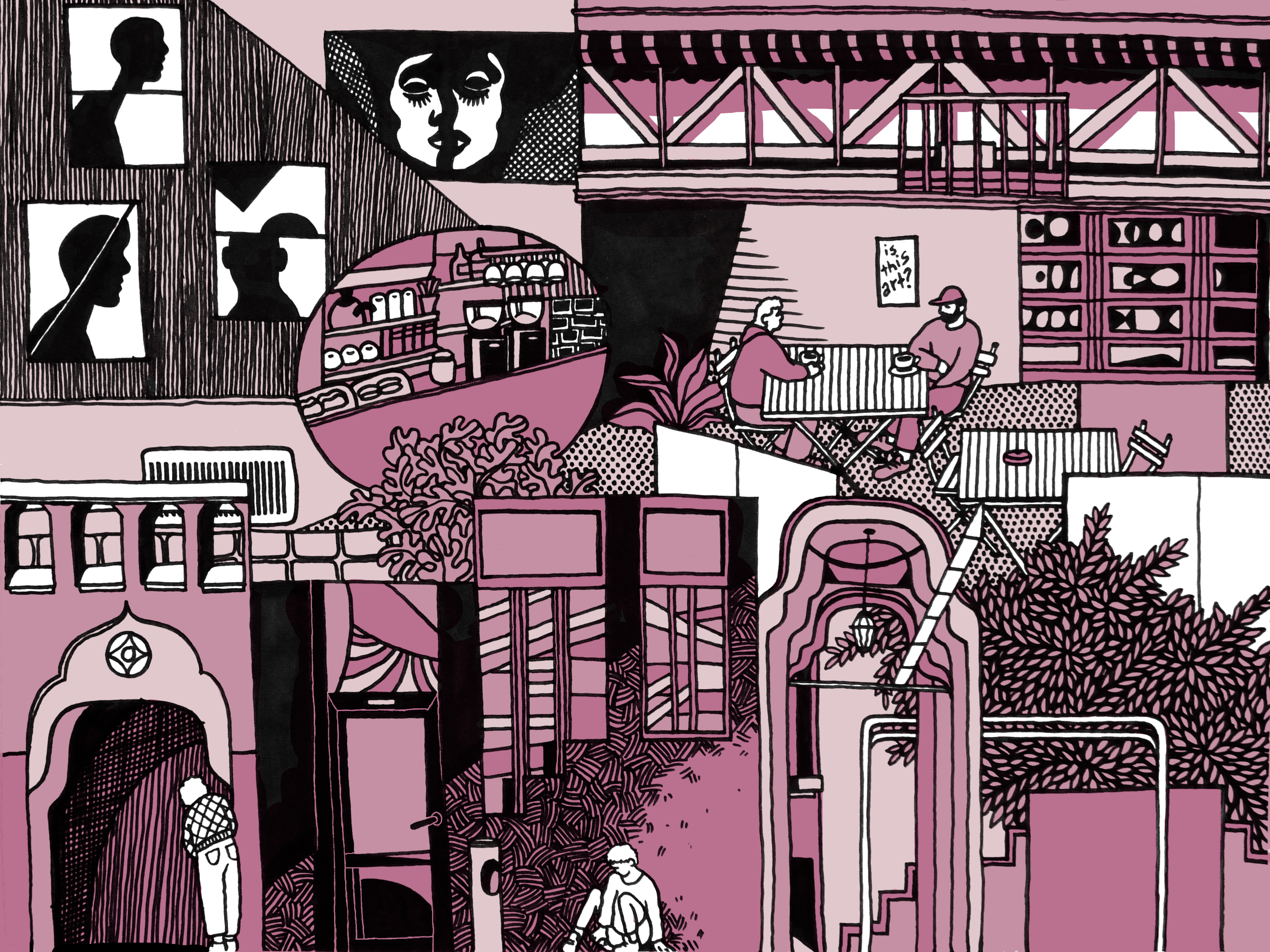
The terrace is pretty busy. Next to Paper Traffic, there's a specialty coffee shop, a cocktail and oyster bar, and Petra — a restaurant serving traditional Romanian food, which it markets, however, as "nostalgia food."
Vlad tells us that before the Disco Obor party series, followed by the Obor Amor bar, the space had been unused for more than ten years — nobody wanted to set up a stall here, far from "the market circuit." For a while, it was even used as a place to sleep by those who "came down from Baia Mare to sell onions off their carts." Things started falling into place once Obor Amor opened, and especially with the coffee shop, which draws a steady stream of customers. A small ecosystem has since taken shape here, where each venue offers something distinct, without overlapping with the others.
Bookstore, specialty coffee, or cocktails and oysters — the rent from all these spaces, Vlad tells us, goes to Cico -a soda company from Communist times-, the owner of the building. It seems that while the name "Cico" was wrapping itself in the air of nostalgia, the company had taken a pragmatic turn and moved into real estate.
I go to get a couple of coffees and join the line that goes out onto the terrace. Back in the day, people used to dress in their finest clothes when going to the fair — a tradition that, I'm surprised to see, has made a strong comeback among those waiting in line. They subtly size each other up and and invite glances in return, it's a dynamic you won't find downstairs — where no one looks at you unless they have a very specific reason for it.
Smoke from the mici grills downstairs rises and drifts into the café, triggering the first coughs. The line moves painfully slowly. I scan the café's interior and notice how differently space functions here. Downstairs, you get used to the baroque imagination with which vendors manage to cram as many objects as possible into the smallest space (without losing the concept!). Here, though, it feels like space is the main thing filling the shelves: a bottle of extra virgin olive oil — space — a jar of artisanal chili jam — space — a bag of single origin coffee — space...
I grab the coffees and return to the table. I ask Vlad what he thinks about the fact that the market crowd and the terrace crowd don't really overlap. He says he doesn't necessarily see it as a bad thing. "I think this terrace brings in people who wouldn't otherwise come to the market. They come here to spend 16 lei on a coffee, then go downstairs and grab some dill, buy stuff from the market. When Petra first opened, there were people in full white tracksuits, sunglasses, and wide-brimmed hats who came to check out the new hip place. 'Let's go eat some polenta!'"
He's often heard criticisms that the terrace is contributing to the gentrification of Obor. But for Vlad, Obor is not so easily swayed — not by just four hip shops. Besides, he believes it's not like the prices up here are dramatically higher than the ones downstairs. People come to Obor to spend money, to shop and eat, and whether they go for a 40 lei portion of nostalgia food from Petra or four mici and two beers from downstairs, they end up spending the same, he tells us.
Behind the market, excavators push piles of rubble from the recently demolished buildings. Vlad tells us that a large-scale real estate project is set to rise here — in a few years, the area will be home to massive residential complexes. For now, the new physical — but especially economic and demographic — landscape of Obor is announced only by the clouds of dust rising in the distance and the thuds of concrete breaking through the terrace music.
Speaking of change, the most noticeable is the arrival of Indian spice shops in Hala Obor and the Sri Lankan restaurant just below the terrace. Vlad tells us the restaurant started out with a single gas cylinder, cooking right there on the sidewalk. "Now they've got tourists coming, and they have Google reviews. And they're really a community — they gather in the evenings with their Glovo bikes, play guitar, hang out — it's really become their place."
We ask what the future holds for the Paper Traffic bookstore. First on the list is to throw a few small daytime parties, where the people mixing the music will also have to mix a platter using only what they find in the market: "They'll have to present both their taste in music and their taste in food."
Vlad's goal is to make the bookstore financially independent from the barbershop and to better define the price niche for the kind of paper-based art he's promoting — somewhere between mass production and prohibitively expensive work. He also plans to continue developing his local editorial projects and to publish more books.
We say goodbye to Vlad, who's expecting a haircut client soon, and head toward the Sri Lankan restaurant — more out of curiosity than hunger. Before going down the stairs, we lean on the railing and pause for a moment to take another look at the ground-floor shops.
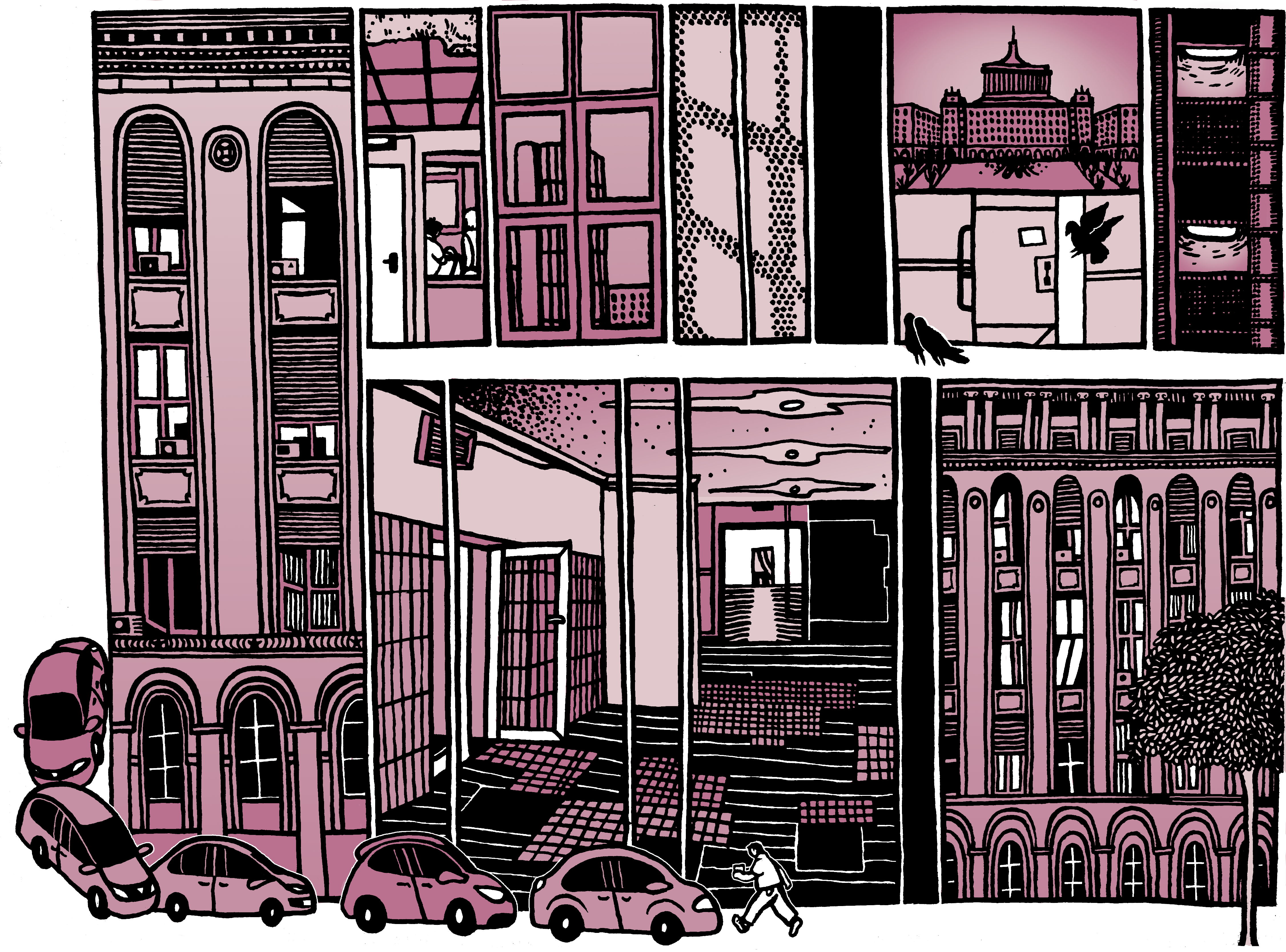
If you take in the stands below in a single glance, a sort of mosaic of everyday life emerges — of its cyclical and universal movements. From the image that emerges, you get the sense that you can piece together a large part of anyone's days.
Looking at those stalls you can see behind the windows that punctuate the apartment blocks of Bucharest — each one signaling a separate and alien life: mustard, oil, canned goods, a blanket, some detergent, a knife, screws, cat food, a pair of socks, and so on, again and again. These objects give a face to the metabolism of a large part of today`s population.
Of course, if the market lets you glimpse something universal about human life, that's because the market itself is shaped in response to human needs. According to Max Weber, the market and the city are bound by an essential connection. More precisely, at least from the perspective of the economic concept of the city, it is nothing more than a human settlement that developed around a marketplace. And the two — market and city — amplify and mirror each other throughout historical change.
If Obor has endured for three centuries, it's because it has kept pace with the needs of daily life. There is a symbiotic relationship between the city and the market, though one which — judging by the advanced age of the majority of those who still come to Obor today — seems in danger of ending within a few decades. You can't help but wonder whether the conditions of life haven't changed too much and too fast in recent decades, to the point where the kind of value that Obor offers may no longer be relevant. And yet, as I take the last sip of my flat white on the way to the Sri Lankan restaurant, it's hard not to feel that perhaps Obor is already beginning to adapt.