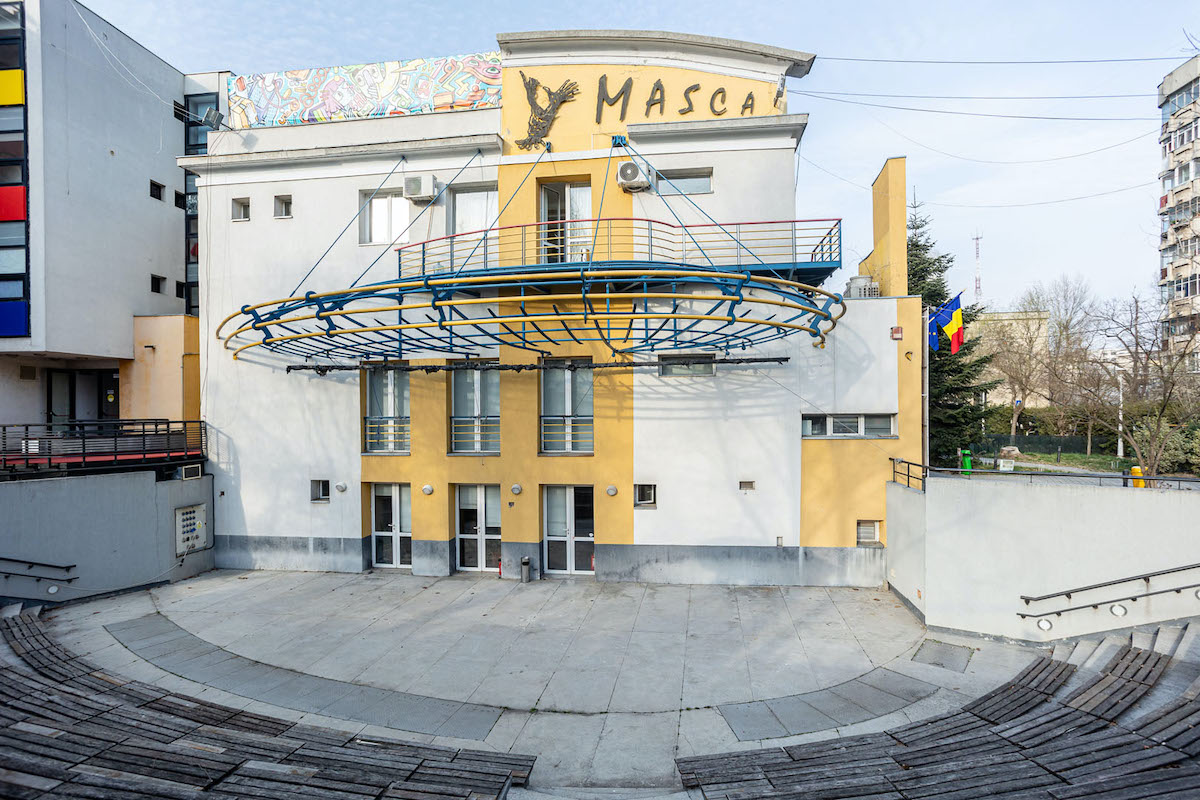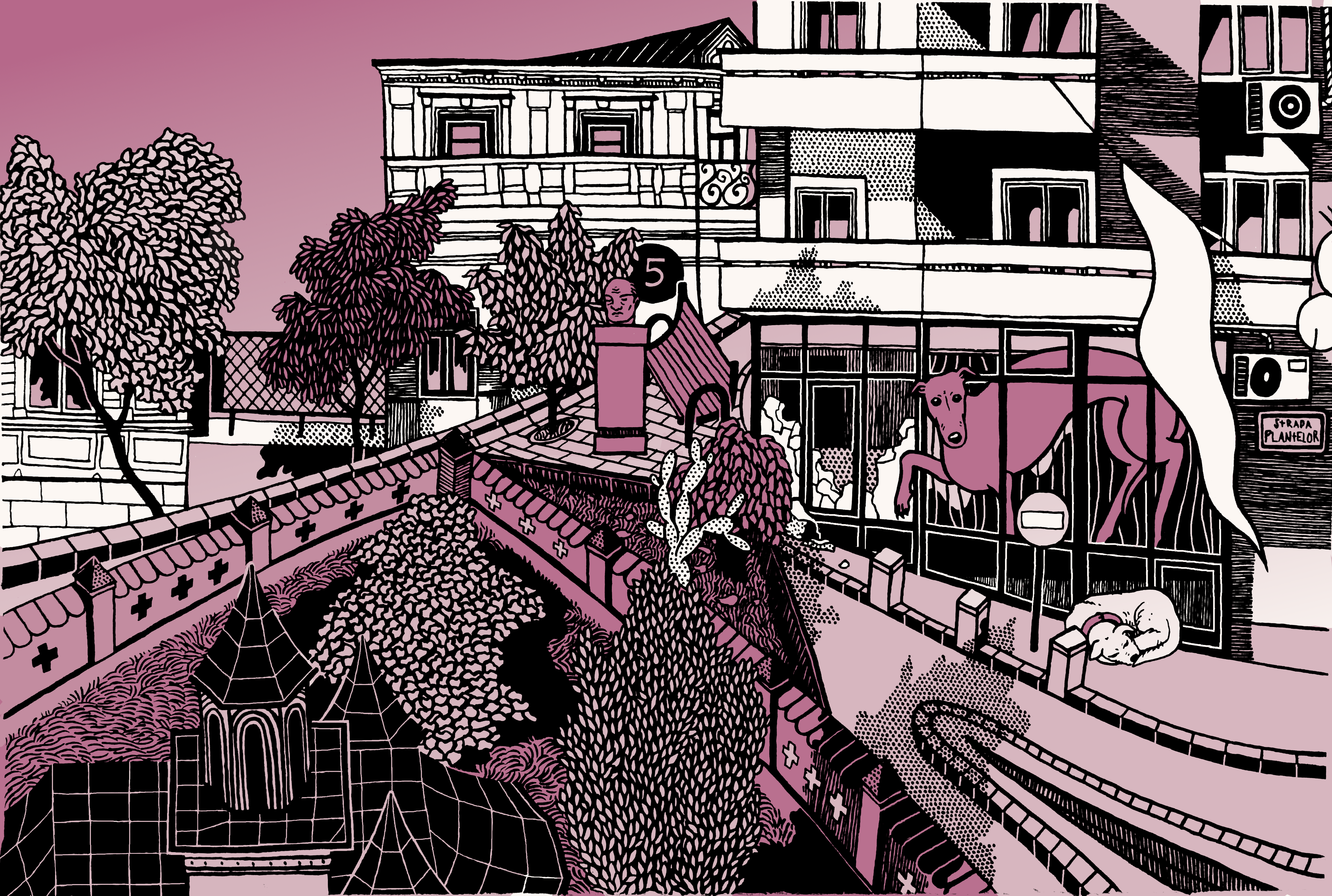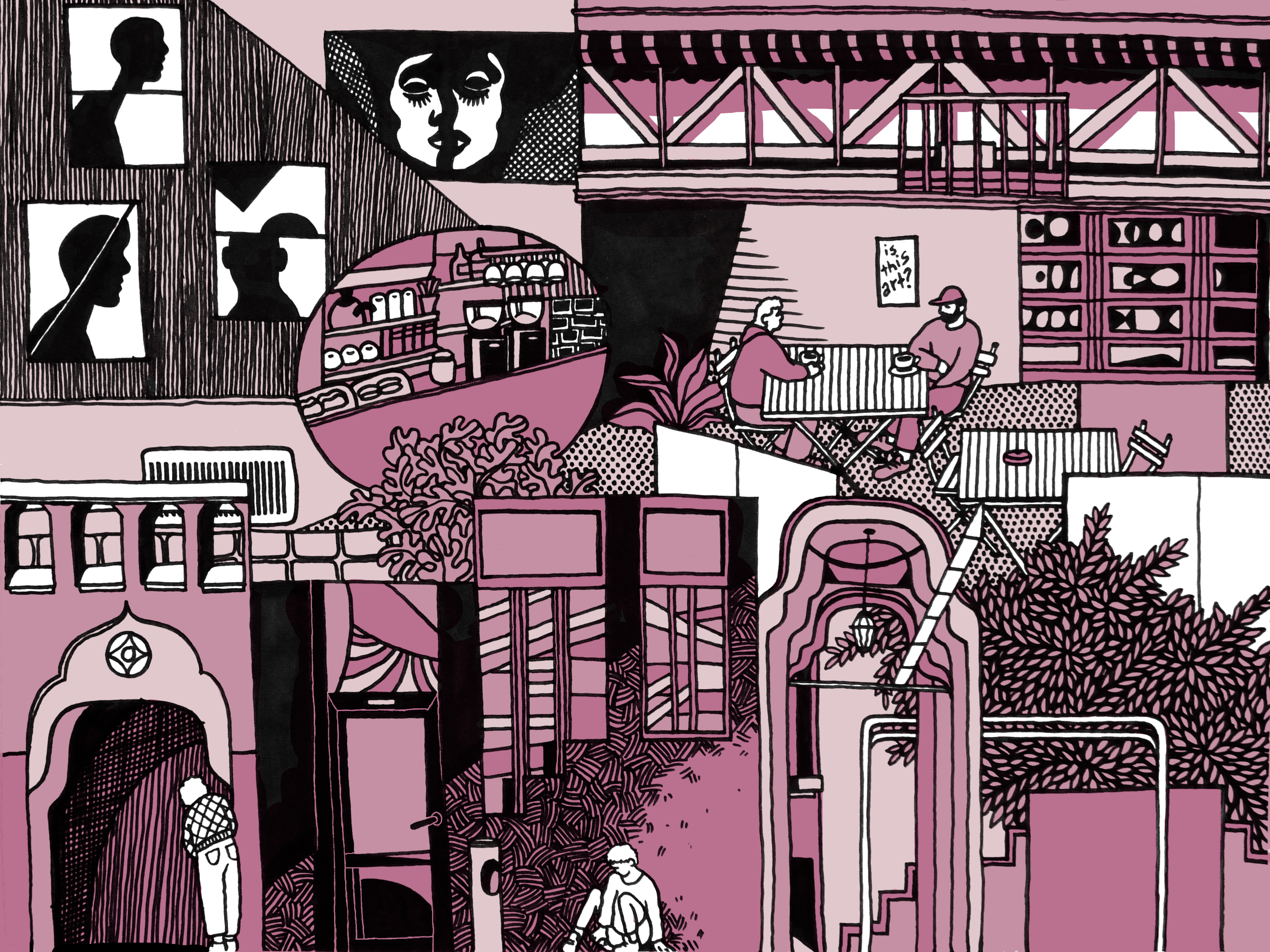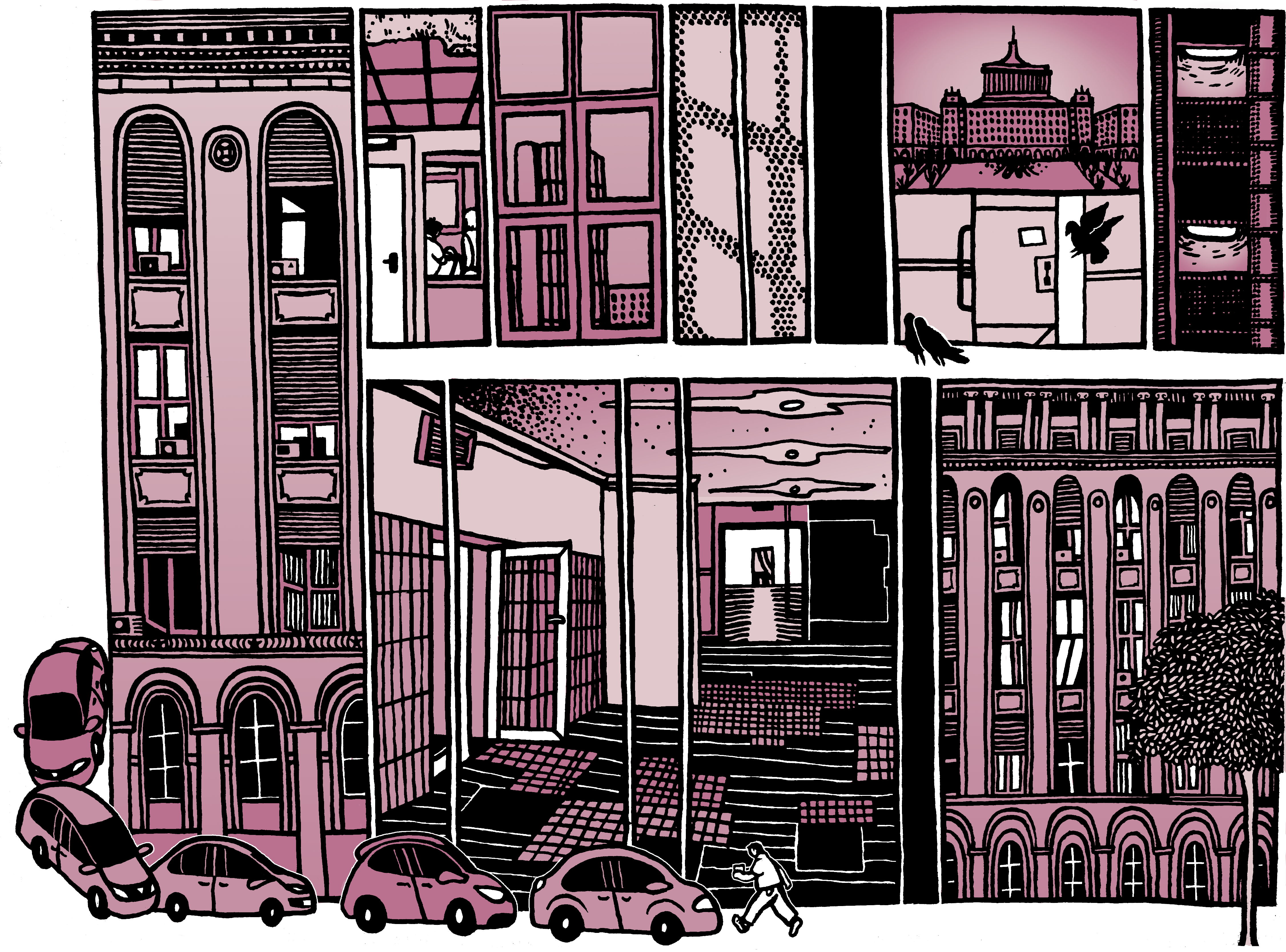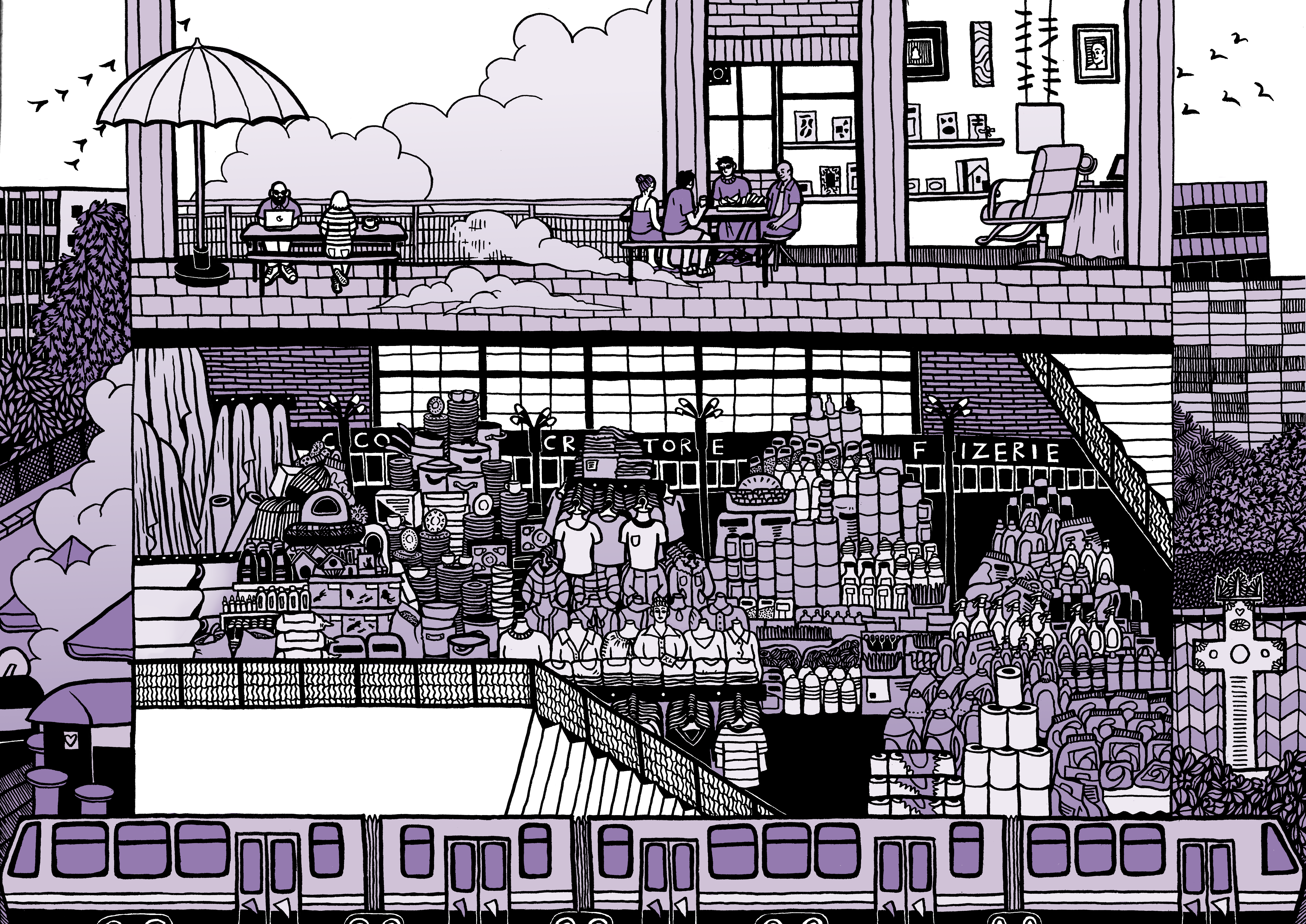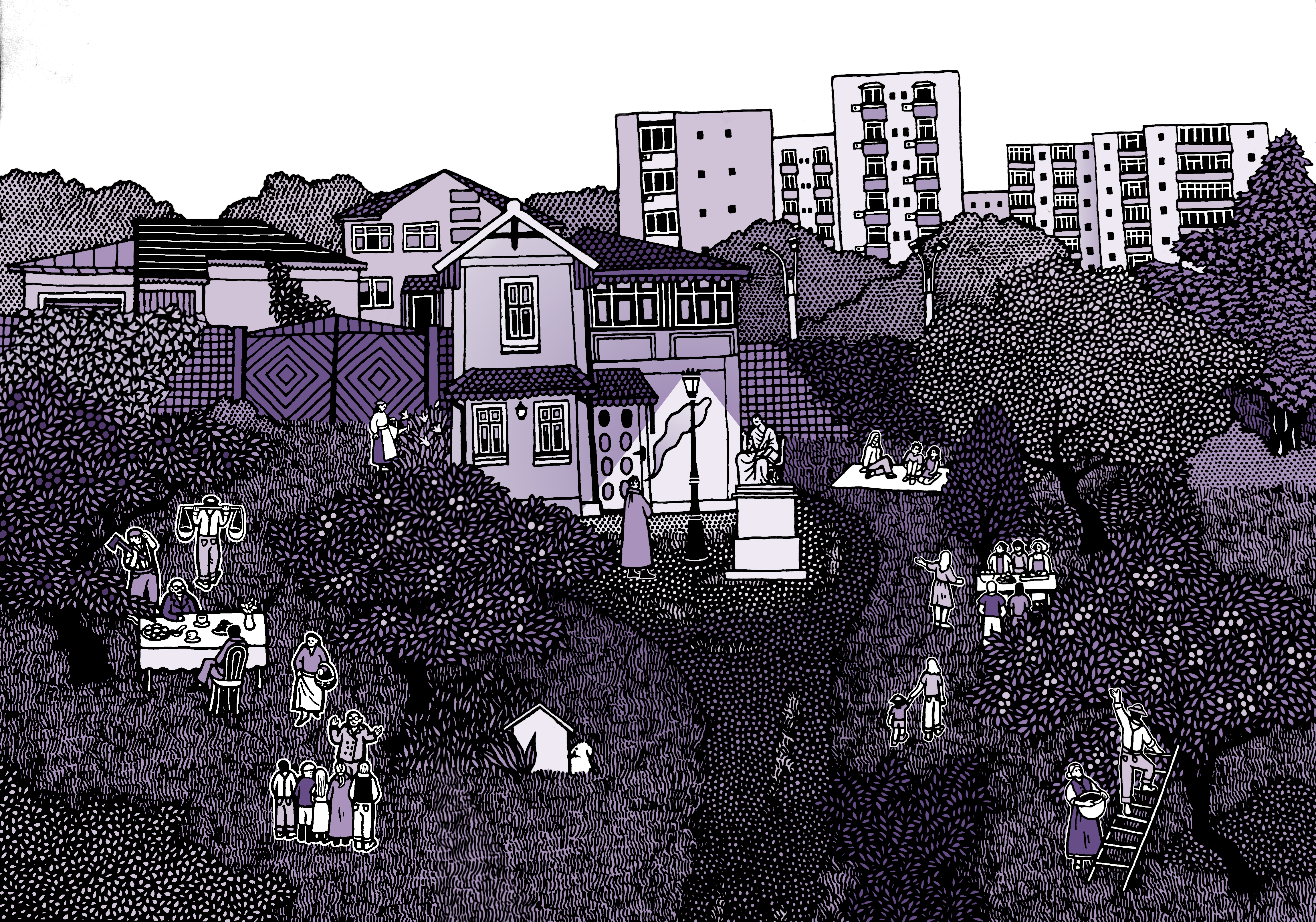
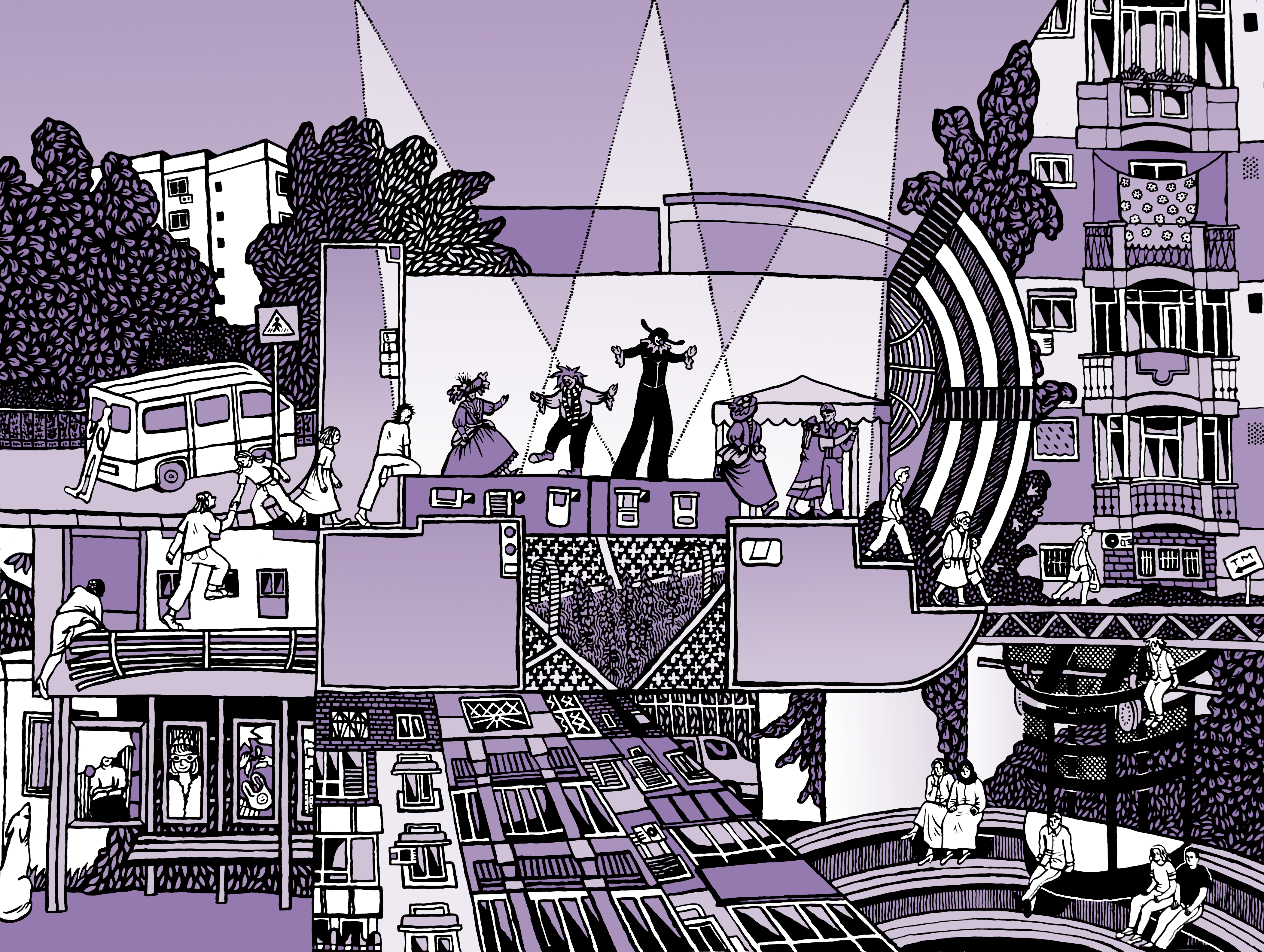
The theater building, positioned between the street and the tall apartment blocks of the Militari "dormitory district," functions as a true contemporary agora. The space includes two performance halls, a civil defense shelter (used, within the limits allowed by law, for rehearsals), a greenhouse, a library, and an impressive rooftop garden. The new wing of the theater, inaugurated in 2010, houses the administrative offices, a costume workshop, a kitchen, and three bedrooms for guests — directors, actors, or collaborators — one of which has access to the building's terrace. Around the theater stretches a garden used either as a waiting space for the public or as a site-specific performance venue. Also located there are the Regina van — a piece of history on four wheels that carried Masca's shows throughout the city — an open-air amphitheater with a capacity of 300 seats, and the kennel of the dog adopted by the team, who was given two names: Grigore and Jardel.
Along with the expansion of the building, a digital archive of the theater's history gradually developed. In 2009, all photographs were uploaded to the Flickr platform, and in 2020 the entire collection of VHS tapes was converted into digital format. Today, Masca Theater's archive is preserved in virtual storage as well as on physical hard drives. The archive, a form of preserving the institution's memory, reflects the care for the heritage left by its co-founders — director Anca Florea and actor-director Mihai Mălaimare — ever since the theater's founding, 35 years ago.
To learn more about the entire ecosystem surrounding Masca Theater, I traversed Bucharest — from Berceni to Militari — on a sweltering June day, and sat down with Cristinel Dâdăl, the theater's artistic consultant since 2009. In our conversation, which has been edited for clarity, we spoke about how Masca, under the current leadership of interim manager Catinca Drăgănescu, aims, among other things, to become the first sustainable and environmentally friendly theater in Romania and to foster a community focused on the culture–education–environment axis. But perhaps the most important aspect is that Masca is constantly seeking an alternative model for reimagining its relationship with audiences, so that the theater can truly function in the service of the community.
On May 24, 1990, by Government Decree, Masca Theater was founded as the only theater of gesture, pantomime, and body expression in Romania. Initially without a home of its own, this condition, as Cristinel says, "haunted" the co-founders. "In September 1992, they took to the streets, in front of the government in Victory Square. For two weeks, day after day, they performed there, they slept there, they drank their coffee there. It was their way of protesting against the indifference of the authorities. Their taking to the streets was born out of necessity."
Faced with uncertainty and lacking a physical space, Masca Theater opened its first season outdoors. This direction consolidated the theater's identity, generating authentic experiences that, over the years, helped bring communities together. "I've lived through situations where teenagers or young people encountered theater for the very first time through a Masca performance in the park. Years later, still in the street, some of them came up to me while I was setting up the stage and announcing the show over the microphone. It moved me to see them again — this time with their own children."
Thus, for a long time, Masca Theater was the only public cultural institution in Romania that, year after year, sustained an outdoor season with productions specifically designed for the street; an institution that continues to this day to operate according to a simple principle: we don't wait for the audience to come to us — we go to them.
"That's when they discovered that between home and work, from point A to point B, people could stop to taste culture — and if they did, they validated the act. From this came the street direction, which had long been validated in Europe and around the world." This direction became a recurring practice, through which the actors understood that they could connect with people beyond the stage — in real life, in the city's neighborhoods. "In the mornings, the actors would call each other: 'Hey, you healthy? / Yes, we're all in one piece.' Then they'd meet somewhere, grab a coffee, and load the props into Regina, a Mercedes MB 100, the theater's first van. They'd climb into the van and set off into the city, looking for the vacant lots that today have been replaced by parking lots. They would wander through Rahova, Ferentari, until they found an open space between the blocks. The first thing they did was clean the place of garbage, dirt, and weeds. Then they unloaded the set and took a walk through the neighborhood, announcing: 'Hear ye, hear ye, tonight we're putting on a play right here!' And in the evening, the show would unfold."
Masca Theater began with a simple vision: the actor holds within themselves all the means of expression necessary for a performance. Founded right after the Revolution, in a moment when the word "freedom" echoed on every street, Masca was, for co-founders Mihai Mălaimare and Anca Florea, a space where freedom meant "the possibility of daring to dream wildly," says Cristinel. "Mihai Mălaimare had been valedictorian of his class at IATC (the Institute of Theatre and Film Arts) when he founded Masca. He could have stayed on that path, but he felt the need to create this theater in which the actor is the custodian of all the expressive means required. That is, the actor carries within themselves everything needed to make a performance: song, pantomime, dramatic and classical techniques. From this, the idea of this theater was born."
Masca Theater transformed different corners of the city into a living stage. It brought performances to unconventional places: from parks to metro stations — spaces where people are either close to home or simply in transit. In Humulești Park, in the Ferentari neighborhood, when they arrived with sets, lights, and the van that read "this truck transports culture," people thought elections were coming. Why? Because the last time the public lighting in the park had been turned on was during the previous elections. "When they realized it wasn't an election, but that we were about to perform a play, they went back into their homes and returned dressed in their good clothes. I found it fabulous that they validated the presence of a cultural act there, in their most natural way. These are the kinds of things that cannot be replicated. They are what remain part of the identity and spirit of this theater."
By performing outdoors, Masca redefined the relationship between actor and audience: in a space without the conventions and strictures of a theater hall, the spectator has the freedom to leave, to intervene, to react spontaneously. It is a space that demands from the actor a kind of vulnerability and openness. "For them it is still a stage, even if it's at street level. This dynamic can create sublime experiences, but it can also create frustrations. It's one thing to watch from a seat, it's another to be at the distance we are now. To see the actor sweating, having to conceal certain gestures or wipe their face — things that inside a theater hall are easily masked. In the street, there are no backstage areas. Everything is in plain sight."
The desire to bring art into places where you least expect it was — and remains — essential to the theater's identity, even though in recent years local authorities and bureaucracy have blocked the path toward sustaining outdoor seasons. "Today it's impossible for us to maintain an outdoor season. It comes down to logistics, transport, and human resources. An inspection or liability insurance for a truck costs tens of thousands of lei. You need approvals from the public domain administration, from the sector city hall, from the local police. In 2021–2022, the procedure became so cumbersome that I said it's great that, after 30 years, we've earned the right to ask for permission to perform for free."
From 1996 to 2004, Masca operated out of the Trade Unions' Cultural Center in Bucureștii Noi. In 1997, when they received the building on Uverturii Boulevard, the spaces were unusable. They moved into the building in 2005 and the first performances took place with the audience sitting on beer crates. There were no bleachers. Cristinel recalls a situation where there were more actors than spectators: "They came out in front of the audience and saw three people, while there were seven of them on stage. 'We're sorry, but we don't think it makes sense.' And the people in the audience replied: 'Don't you want to perform? We want to see you.' So they performed."
Masca Theater has also been present in the public spaces of the Militari neighborhood. They performed at Politehnică, Păcii, in Crângași Park, on Iuliu Maniu Boulevard, at the former Giulești cinema, and all the way to the SIR shopping center — including in front of the Lujerului metro station. During the pandemic, they launched the project "Far from the center, close to the people," through which they invited state theaters from Bucharest as well as independent troupes to stage performances in Masca's amphitheater during the summer. The initiative aimed to bring theater closer to the local community, for whom distance, transport, or costs often make attending shows in the city center more difficult.
As for the role and importance of a neighborhood theater, Cristinel emphasizes that theater is a necessity for everyone, whether we realize it or not: "Does a neighborhood need a pharmacy? Yes. A supermarket? Yes. The same goes for a theater."
Although it defines itself as a "neighborhood theater," Masca has gone beyond the boundaries of its physical venue and its Sector 6 neighborhood, being present for years in other dormitory-neighborhoods of Bucharest as well — places where cultural infrastructure is either nonexistent or exists only on paper.
"Street performances accounted for 75% of our activity during Anca Florea's last term. And the relationship with the venue followed the same spirit. There were events that involved open-air performances, but also the idea of community, because we went toward communities through these shows. Masca Theater has built communities beyond its venues."
This openness contributed to the growth of an audience that is not made up primarily of people living in the apartment blocks surrounding Masca Theater. These are communities that Masca reached through street theater. "It's another way of connecting with the audience, of drawing them here — something that maybe wasn't even initially planned. Anca Florea had a saying:'Come on, Cristi, let's figure it out as we go.' The people who came to our shows in IOR Park became a community. They began to get to know one another, they gave us their feedback, they had the joy of rediscovering actors they already knew from other performances. Maybe one year they were living statues from The Forgotten Trades of Paris, another year they were characters from Calea Victoriei at the end of the nineteenth century."
If in the case of the Center for Resources in Photography (CdRF), which we wrote about here, the "third space" was represented by the inner courtyard, in the case of Masca Theater, Cristinel wishes this space to be the theater itself. It is worth recalling here the words of sociologist Ray Oldenburg, who defined the "first space" as the home, the "second" as the workplace, and the "third space" as that informal place where people meet, speak freely, and forge genuine connections.
At present, Masca dreams of a concrete transformation that would complete the idea of a "third space": removing the fence that surrounds the institution. Such a gesture would open the place both physically and symbolically to the neighboring community. Without this boundary, people could step into the courtyard with the ease of entering a small park, without feeling it to be a forbidden or overly official territory. The idea is not merely to remove a fence, but to build a relationship between a public institution and the people around it — to remind them that this space belongs to them as well. However, removing the fence would require the installation of additional security posts, and such measures involve costs that Masca, at present, could hardly afford.
"We dream of Masca Theater's space, starting with the courtyard, becoming a community space. The person living in the block next door doesn't think of this space as theirs. But in a way, we believe it is theirs, because we are an institution funded by the Bucharest Municipality (editor's note: in 1999, by Government Decree, Masca Theater passed from the Ministry of Culture's authority to that of the City Hall). Just as the city hall provides residents with access to gas, electricity, or public transport, I believe we are also a public service, in the sense that people need culture, whether they are aware of it or not. And here lies another challenge — how do you create the context in which they come to realize that, in fact, they can consume culture?"
Today, Masca Theater defines itself as a center at the intersection of research, education, culture, and the environment. Starting with the 2025–2026 season, the theater plans to provide audiences with information about the proportion of reused and recycled materials used in the making of its performances, in line with European Union standards. For the people behind Masca Theater, however, sustainability — or the "grammar of ecology," as Cristinel calls it — is not limited to ecological aspects. It also translates into care for underrepresented communities — children, teenagers, and seniors — through long-term workshops and projects dedicated to them. Thus, the theater no longer bears only the emblem of a cultural institution looking exclusively inward, but takes on the role of a living organism, one that exists in the service of the community.
"We run workshops for children (Masca Junior) and we have a troupe of teenagers adopted from the Iuliu Maniu Technical College. In 2023, we began working with them on the project 'The Voice of the Bucharest High School Theatre', and we continue to collaborate with them today, independently of this project. They meet weekly and work on a performance based on their current experiences, struggles, and needs. We also have a troupe of seniors from Sector 6, with whom we connected through the European project Human Mosaic, where we prototyped a community performance made entirely with members of the community, not professional actors. We wanted to give a voice to underrepresented communities — children, teenagers, and seniors — and to begin with separate workshops, looking for that common thread needed to weave a performance. The relationship with the seniors continues to this day: they work alongside Ana Maria Pîslaru and Sorin Dinculescu, our actors from Masca Theater's very beginnings."
This year, on May 24, Masca Theater celebrated its 35th anniversary. On this occasion, they published a bilingual catalog written by Catinca Drăgănescu, based on research conducted by Radu Crăciun, a researcher in the research, development, and innovation department at UNATC. For this catalog, they wanted an external, critical perspective that would reconstruct the institution's journey. Catinca crafted a narrative that recovers everything that has taken place at Masca over the years, where it stands now, and where it hopes to go.
"One of the hidden messages is that we are continuing the founders' madness. This is ongoing research, and I'm curious to see how it will be documented at the 70 year anniversary."