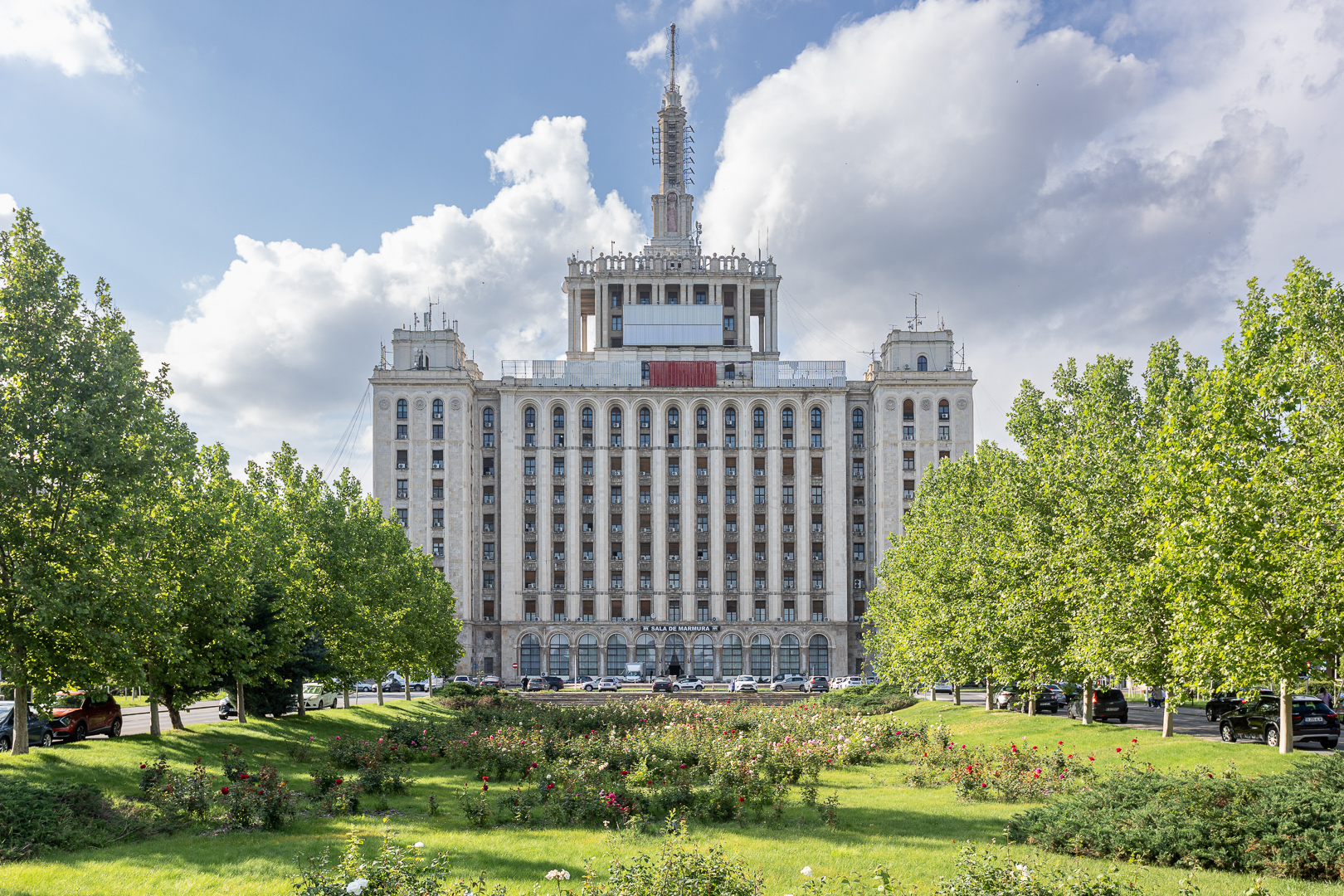
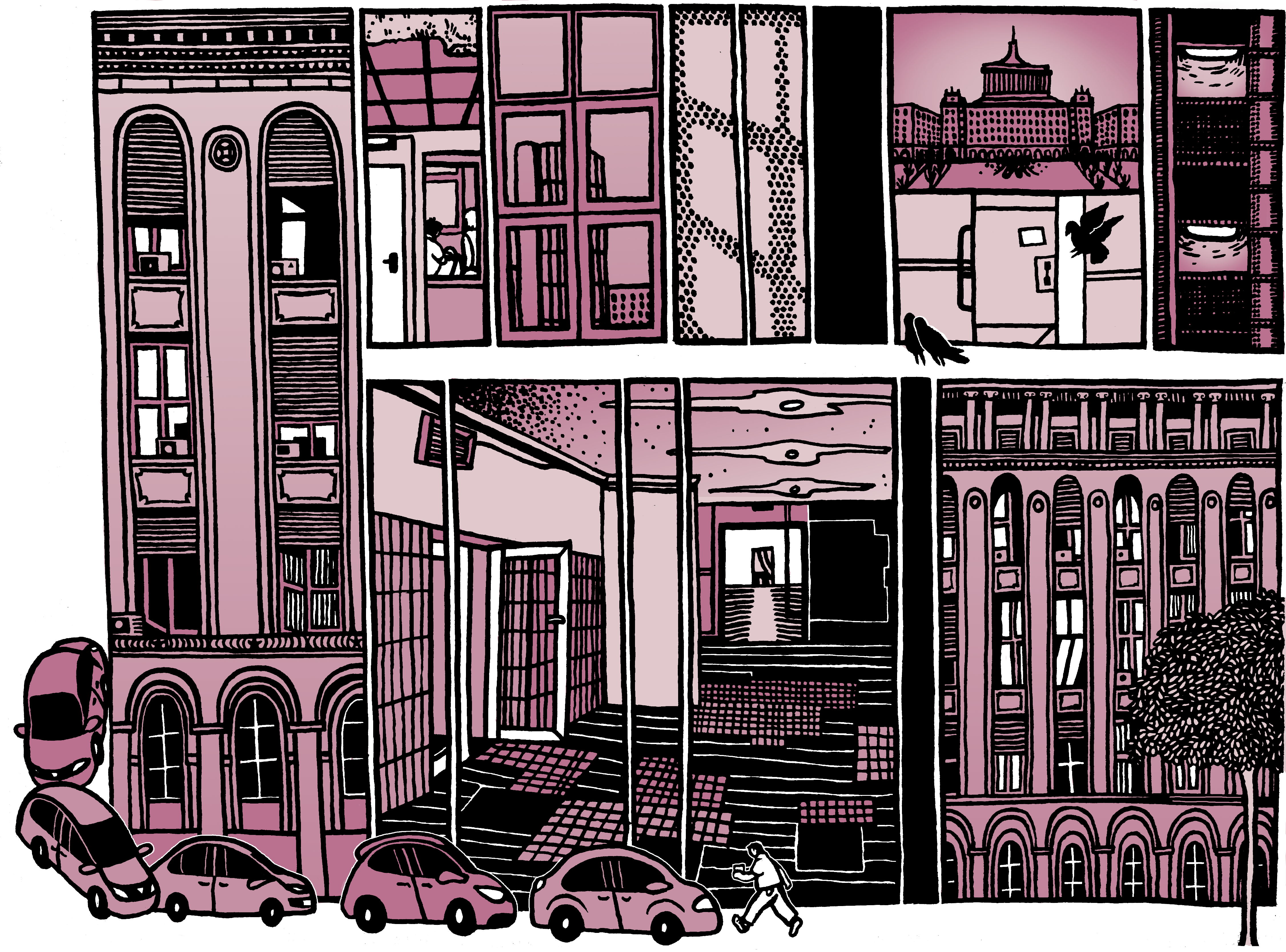
Casa Presei Libere is the kind of place we're only used to seeing from the outside - from a bus, a car, or from a distance. Until 2007, it was the tallest building in the city. You always wonder what's there, what goes on inside? A product of socialist realist architecture, Casa Scânteii was designed in the image of some of the landmark buildings of the socialist regime - Lomonosov University, the Leningrad Hotel in Moscow, and the Palace of Culture and Science in Warsaw. The building has become an emblem for Bucharest, but until recently it never gave the general public a good reason to actually interact with it. The Atelierele Scânteia initiative seeks to change the rules of the game and bring the place closer to the inhabitants through exhibitions and events organized in the A2 building.
"If you go through that corridor, past the Marble Hall, and stay within the courtyard, you'll see Ateliere Scânteia. Then you go up the stairs to the elevator. It's the easiest way," Vlad Albu explains to us after we got lost trying to get to him and Gia Țidorescu. At the Malmaison Workshops, housed in another historic building that has served as a garrison, prison, and courthouse over the years, you will find the same labyrinth-like structure. Both are massive buildings with winding nooks and crannies. Their sole purpose seems to be to prevent you from getting to your goal simply and straightforwardly.
Although there are many buses that go to Atelierele Scânteia, Gia says that most people are discouraged from coming because of the distance. A possibility would be to join forces with other cultural spaces in the area when organizing events, such as Combinatul Fondului Plastic, another cultural centre built in the late 1960s that brings together several galleries and workshops for artists and craftspeople. "If there's a bigger facility, people are more tempted to make the effort to get out [of the house]," Gia says.
Vlad lives near Ștefan cel Mare and can easily get to the workshop by bus or bicycle. He says he comes about three days a week. "I think since I have a place, I'll try to get into a rhythm." Gia moved to Bucharest from Cluj a year and a half ago and lives in the Titan neighbourhood. It's about an hour and 20 minutes from her home to the workshop. Half of the week she goes to a part-time job, and the other half she comes to Scânteia, where she either works on projects for her space, Calciu Space, or writes articles and texts. "It's quiet and I work much better than at home".
We asked them what influence, if any, has their stay at Atelierele Scânteia have on their art. "It is very easy to come up with more ideas when you can also put them through the filter of people whose work you respect," says Gia. Vlad benefits from having a space in which he can experiment with different types of materiality. "It's quiet, it's good light. You leave the house thinking you're going to get into that state, without necessarily intending to, and you stay there. You can also take a break and have a coffee and a chat. It's nice."
The Scânteia workshops are only a small part of the activities that take place in the A2 building. Many of the Casa Presei`s spaces are still uncharted and inaccessible, and those that are in use make up an eclectic landscape. In the artists' wing there's also a culinary photography studio, a fencing room, a dance studio and three TV stations: Metropola TV, funded with public money and owned by Florentin Pandele, the mayor of Voluntari; Agro TV, which Vlad says are not the most communicative bunch, but they do come to see what's going on at their events; and the Inedit TV studio, a TV station where, when they're not talking politics, they broadcast folk music.
When the workshops opened in September 2023, Metropola came to them and suggested they do a piece on the space, but the proposal never materialized. "I don't even know if they insisted, and I don't know if we would have necessarily wanted to," Vlad says. Also at that time, Gia was asked by Metropola how artists manage to finance themselves. "More specifically, how do you make money? Gia explained that through collaborations with different institutions, public grants, but also by selling work. It's important for others to see that there are other sources of funding besides salary, and to be open to working on one-off projects, she believes. "No matter how much I tried to explain it, somehow it didn't seem to get to them."
The fact that the workshops came about benefited not only the TV stations, but also the other activities taking place there. Before the artists started to renovate the space where a CD factory had been operating for many years, this area of the building had been colonized by pigeons, untouched and left to decay for 5-7 years. Most of the employees of the three TV stations had to cross the deserted corridor. Now the corridor is all clean and nice. Yet, the pigeons that used to come in through the broken windows still haven't gotten used to the fact that their former meeting place is now inhabited, and they continue to squeeze their way in however they can.
The Coresi publishing house, which laid the foundations of the printing industry in Romania, still operates out of Casa Presei and owns the side of the building that houses the workshops. "The director probably thinks we're doing something completely different than we are. I mean, he has a different idea of the art that's being produced here. But he is glad that people from the cultural sphere have taken over the space and he is trying to support what is happening here," says Vlad. We also learn from him that the publishing house has an institutional archive run by a senior woman archivist. It contains all the employees' pay slips, pictures from 1956, when the publishing house opened, and several hundred workers' portraits from the 1970s and 1980s.
Together with other artists, Vlad has set his sights on scanning the archive and creating a small intervention on the occasion of the open doors event at Atelierele Scânteia this fall. "We want to make the archive accessible to the public. We need to find just the right format to multiply the materials so that people can take a piece of the archive home with them. We want to create stories around it, and even to learn from people about the history of the place, to fill in the blanks and create a dialogue between the public, us and the Coresi."
As I said above, getting to Atelierele Scânteia from different parts of Bucharest can be a time-heavy adventure. That's why, once you're there, you can't afford to leave so easily. No more arranging lunch dates or coffee breaks. As soon as you step off the bus that takes you to one of the few stops that flank the colossus known as Casa Presei, you're wedded to the place: "If you're making a three-hour round-trip home, that's a commitment," Gia says of her schedule. Being away from home and downtown, however, has an anti-procrastination effect. "A lot of things distracted me at home. Here I can focus," she adds. The area seems to operate in a fairly closed dynamic, but that's not necessarily a negative for artists who want a bubble of tranquillity. The studios are also quite isolated from public space. The perimeter of Casa Presei is almost entirely for traffic and cars. "You don't hear about us from the street and then walk in," Gia points out.
The former Casa Scânteii resembles an island or a cruise ship: as soon as you enter the building, the shore - the city - disappears. Once inside, it's best to let the logic of the place assimilate you, as the options are very limited anyway. "At noon, you have to go very quickly to get a meal. There are some places where people from the ANAF and other institutions go, but if you go there at half past one to get your lunch, you won't find much," explains Vlad. It's best to bring your own food. In other words, you're either synchronizing your bodily rhythms with those of the other employees in the building, or you're on your own, and the surroundings have little to offer. Vast as it is, Casa Presei doesn't leave much room for wandering or unnecessary pleasure. Its monumentality almost induces a kind of asceticism.
The Scânteia workshops have been set up on the site of a former CD factory, and the layout of the premises has largely remained that of the original. Everyone stepped in as much as they could. Vlad's workshop used to be, most likely, a storage room, while Gia's was a continuation of the technical room. "I knocked down a wall, originally there were two rooms. But otherwise, around the perimeter, [the space] stayed pretty much as I found it," Vlad recalls.
Many of the workshops have windows overlooking the main hallway. Vlad has such a window right at the entrance near the door. More often than not, people knock on his window rather than his door to say hello or pay him a visit. A legacy of the CD factory and completely unnecessary, the window has become a playful element for interactions between him and other artists or visitors. But there is also a certain pressure in being seen. "Ever since we opened, I've been wanting to ask Vlad if this is what your room would look like if it didn't have a window looking in. Because it's so beautiful," Gia laughs. "The other day it was a disaster here because we were working. There was dust, there was mess, we cut the tiles, there were chips. I did a little cleaning yesterday. I'm not ashamed to leave it as it is, it's a workspace. At the same time, several people have asked me why I don't cover this window. You know, because it's privacy," says Vlad. At this point in the discussion, we were secretly thinking that it would be interesting to see studies of audience effect in typical interactions in arts communities, not just in sports, competitions, or morality.
The monumentality typical of socialist-realist architecture cemented a certain type of relationship between the state and the people. Even without the Scânteia newspaper, the propaganda of the PCR, and the dictatorship, it is difficult not to feel an irreparable distance between oneself and what was for years the tallest building in the city. When you reach the 90-meter-high walls of the central body of Casa Presei, something almost inhuman looms in front of you, which you can barely captured in your line of sight. Or, in any case, it is space that tells you right from the start: "You are very small."
I asked Vlad and Gia how they feel about the past of the former Casa Scânteii, and how they negotiate the building's vast spaces. "I think that the building`s past can easily go unnoticed. Or maybe we don't feel it. Apart from the fact that you know where you're coming in, you know what was here, you realize it's a monumental thing, its past doesn't feel like a burden to me. It has a past, but some people worked here," says Vlad. Turning our attention to those who once worked in one of the building's 6000 rooms is comforting, it brings back the human element into view.
But the spatial configuration is hard to ignore: almost nothing in the building is designed with the human scale in mind. Gia tells us that the solution lies in the relationships with others and the intimacy that gets created within the segment of the floor occupied by the workshops: "Somehow you relate to your own and you don't feel [the vastness of the place] anymore".
In addition, the space in which the workshops are located is modular, unfolding as a sequence of 16 larger or smaller compartments. Fortunately, the segmentation tames the dimensions a bit, especially horizontally, and things take on a more human feel.
Vlad's studio is minimalist, brightly light and about 5 meters in hight. On the floor below, where the bookbinding department of the Coresi printing house is located, the ceiling rises to more than 7 meters. The monumentality of the building begins to be felt inside. In terms of surface area, "the [Coresi section] is twice as big as this one, it's an open space where you can see some supporting pillars. About 20-30 women work there, in a space that was clearly designed for many more people. You can feel that everything is huge". The few people working on the machines seem scattered in a space that is absurdly large for their needs. As one might suspect, monumental projects leave behind a large amount of waste. Unfortunately, this cannot be repaired by human relations and solidarity.
I read somewhere that the total length of the corridors in Casa Presei is 3 km. Vlad and Gia told us that they haven't explored the whole building yet, and that much of it is unused anyway. There's already a pattern of Bucharest's independent artists finding spaces for their workshops and exhibitions in places left abandoned after the fall of the Ceausescu dictatorship: Atelierele Malmaison stands where a prison of the same name once stood under communism; WASP has taken over a former industrial hall of the Flaros factory; Make a Point has held art events in a hall of the former Postăvăria Română textile factory and in the water tower in its courtyard. Of course, the conversion of industrial heritage can also lead to the emergence of other types of venues, an example of which is Halele Carol.
There is room for more cultural spaces at Atelierele Scânteia, which would most likely bring more visitors and more collaborations between artists: "If there were other performing arts institutions or something else in the cultural field on this floor, it would certainly be better," Vlad thinks. There is also a private gallery, ARSMONITOR, in the same building as the workshops, and the good news is that a second independent space will soon be inaugurated on the ground floor of the building, which will be attached to the workshops and will host exhibitions, concerts, performances, and so on: Scânteia +.
Gia told us that the space she runs, dedicated to young curators, found its name after a late-night brainstorming session. "Calcium", the final name, refers to her interest in the intersection between contemporary art and research in the field of biology, as well as to the calcification process of an artistic project, the processuality and the path that leads to the final result.
If we extrapolate, what is currently happening at Atelierele Scânteia resembles a slow and fragile calcification or sedimentation of a project and a community. Unfortunately, all this is happening (for the time being) without the political and financial support of central state institutions.