In a city, the past usually appears discreetly — in architectural styles, in details found on façades, in the names of streets, high schools, and squares, in the layout of streets, monuments, clocks, and fountains. A memorial plaque high up in a corner, a century-old awning in a former working class neighborhood, an old tower in the morning light, a clock that chimes the hour with sounds from another age —we might glimpse them in passing, if only for a moment. "Who were Ion Cîmpineanu or Popa Tatu, I wonder?" As we go about our business, fragments of the city's history cross our path daily. We interact with them in passing, sometimes almost on the run.
In contrast, museums and memorial houses present the past before us in a static, concentrated form. A memorial house approaches us with an entire procession of objects and stories; a meteorite shower fallen from the everyday life of people long gone. We encounter these worlds of the past under the shelter of an institution that has already consecrated them: they no longer need our recognition — it has already been bestowed. We therefore take time out of our own lives to rest our gaze on surfaces, textures, forms, and tools that are not part of our everyday, but which we are told ought to speak to us.
The Tudor Arghezi Memorial House, located in the south of Bucharest on Piscului Hill, is something of a teleportation portal into a household from the early twentieth century. The physical presence of objects from that time differs from that of today — it seems more sharply defined and more carefully tended. Wooden furniture, the old radio, the wooden tub, the parquet brush, the butter churn, the wringer, the samovar, the Atwater Kent radio, the gramophone, the children's dolls and crib, powders and perfumes, the spines of old books, thick-rimmed glasses, writing instruments — at first, I didn't even have words for many of them, but I admired their material, their shape, their weight. I tried to lift the metal parquet brush and found it impossible. The Arghezi family lived surrounded by tools and devices from a time when plastic was not yet the main material we interacted with. The technological distance makes historical monuments seem to us, the ones living after two industrial revolutions, confined to "a past of the past," as Françoise Choay put it.
But isn't this a rather too simplistic way of speaking about the trove of objects on Mărțișor Street? A samovar here is worth far more than one in a less famous home. The radios from the 1930s on Mărțișor evoke more than just the history of technology — they point to Arghezi's faith in the „magical waves". Although memorial houses can be highly relevant for anyone concerned with material history, by their very nature these dwellings elevate the objects they contain to a higher status. They are objects once touched and used by a creator remembered in history as a genius — painters, poets, architects, politicians, and so on.
After all, what is a memorial house if not a secularized version of the old reliquary? And where does the value of these dwellings come from, if not from their contact with an extraordinary personality — in other words, from the secular, romantic version of the saint: the genius?
As an individual's contribution to the cultural treasury takes shape, the house and the intimacy in which they lived fall under the gravitational pull of the "Work" and almost inevitably metamorphose into a historical document — sometimes even during the person's lifetime. In Arghezi's case, the poet-builder had already planned ahead, arranging to donate the house to the Romanian state, knowing that his dwelling would enter the circuit of collective memory. We can imagine how, in the wake of this testamentary decision, little by little, a certain anterior future began to lay claim to the rooms, the furniture, the objects — from the most ordinary to those closest to the "hearth" of the work: the desk, the library, the fountain pen. Beyond the house's documentary value, its magical bond with the one future generations would celebrate as the creator of a new poetry also began to take root.
Historical monuments emerged in the European space in the context of valuing art per se and of the emergence of History as an autonomous discipline. A Gothic church has heritage value, as we say today, not because it is a place of worship but because it is a historical document: it speaks to us of the art, craftsmanship, and worldview of our predecessors. The same goes for memorial houses: they battle against forgetting and hold value as historical documents. But their true identity comes from elsewhere — from their contact with someone who, professionally or artistically, "made history." The way in which canons (literary, artistic, etc.) are established is a topic that would require a separate discussion.
Things can also be viewed from another angle. The trove of household objects, materials, and devices brings memorial houses closer to the collections of museums devoted to the material culture of a group or an era (ethnographic museums, archaeological museums, etc.). Yet there is a notable difference between the two categories of institutions. A memorial house offers us a whole: the objects, the rooms, even the works of art it may contain are preserved here in their original context. If a museum relocates objects from their place of origin into a glass case, a memorial house "freezes" everything in a configuration as close as possible to that of the past. The first creates collages; the second is more akin to the technique of photography. In other words, in a history-focused museum we encounter objects meant for a gaze that keeps its distance, while in a memorial house we stumble upon things: when we see Paraschiva Arghezi's powders, we can almost picture her standing before the mirror, using them.
So, what is a memorial house, in essence? Many answers may come to mind: a portal to the past, a carefully staged scene protected under a glass dome, an opportunity for all generations to see and feel what life looked like before they existed, a place where present and past coexist, a tribute to a person who, for some, made history. Half historical document, half relic invested with a certain secular sacrality, memorial houses contain a world in which two clocks are ticking.
There are several ways to tell a story about today's Tudor Arghezi Memorial House — not necessarily a definitive, all-encompassing one. To begin with, it is vital to set aside the quotation marks around Arghezi's name and not see him as a kind of brand or literary commodity. The next step would be to return to the beginning of the twentieth century.
Arghezi decided to buy land in an area that, at the time, lay at the edge of Bucharest: Mărțișor Street — "Beyond the Șerban Vodă cemetery, Mărțișor Street began in the Brickmakers' neighborhood and descended over Piscului Hill down to Calea Văcărești. The neighborhood on Mărțișor Hill belonged to the estate of Văcărești Monastery, being covered with vineyards as early as the sixteenth century." In the nineteenth century, the vines were devastated by phylloxera, and the hill began to be parceled out with new houses: people from Oltenia and Transylvania came to try their luck in the capital, which between 1900 and 1930 was experiencing a demographic boom. People worked by the day or found jobs in nearby factories: they were cart drivers, cooks, carpenters, guards at the Văcărești prison across the street or at Abator, Adesgo, Le Maître, and others. Their lives were rural, modest, and most infrastructure was lacking. Arghezi's first contact with Mărțișor Hill most likely came from the window of the neighboring prison, where he was incarcerated between 1918 and 1919 for his pro-German articles. Out of that distant gaze, a house was to be born.
In 1926, he moved to 26 Mărțișor Street with his wife and their two children. Across the road, the silhouette of the former Văcărești Monastery could still be seen — turned into a prison as early as 1864 and absurdly demolished in 1986. In the tavern „La Mandravela" (in the area of the former BIG store), the sounds of gypsy bands and intrigue filled the air. For the construction of the house, Arghezi collaborated with the architect George Matei Cantacuzino, though his own imprint remained significant. For the walls, he used a material that would be considered atypical today — bamboo fiber mixed with cement. Once completed, the house had one floor, 18 rooms, an attic, a wooden balcony, two turrets, and various outbuildings. The construction lasted about 12 years, until 1940 — "I was writing and building. When that fellow laid a brick, I would write a verse. That's why I was writing somewhat par brides."
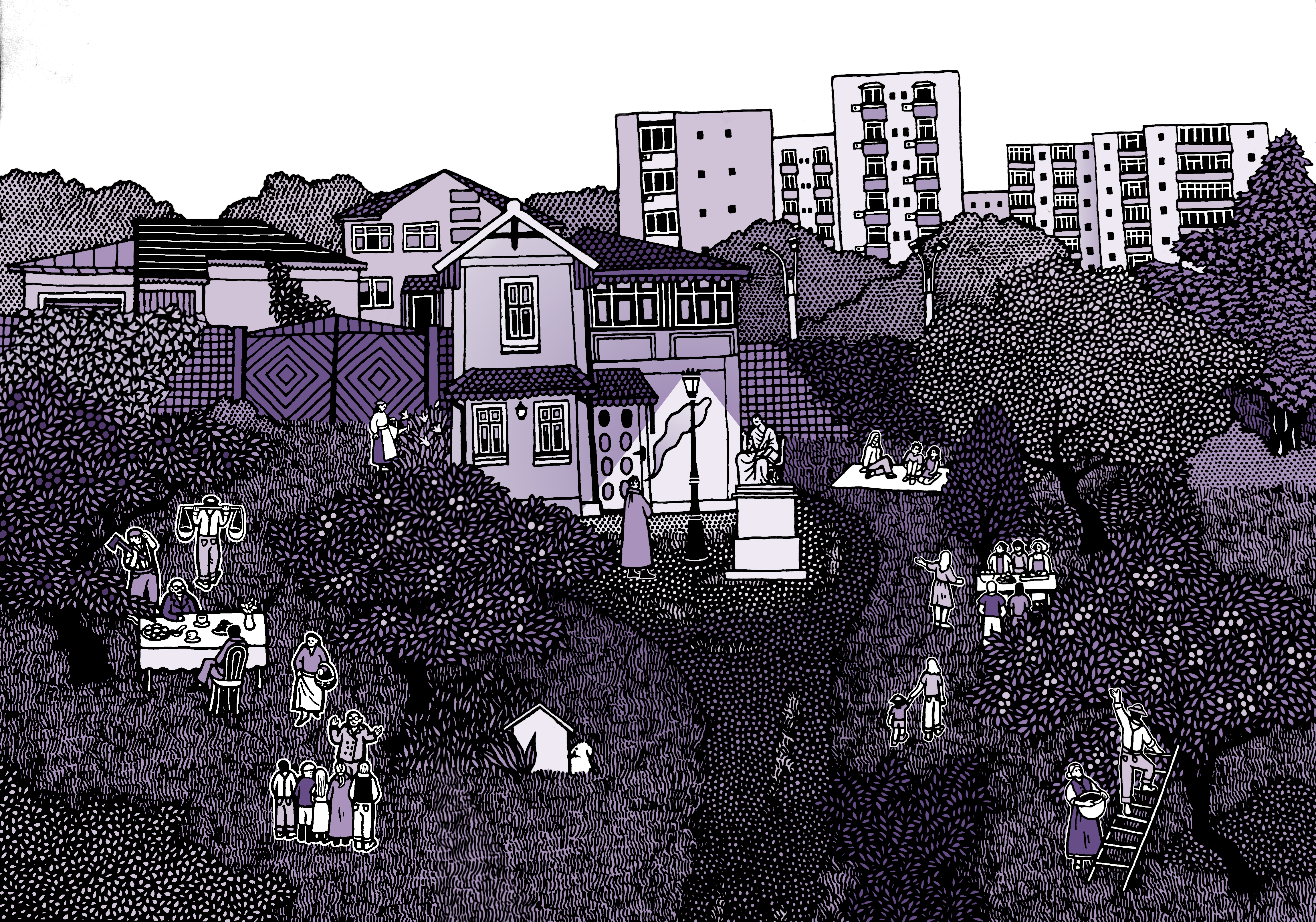
Almost ten years after his arrival on Mărțișor, in 1935, Arghezi received a visit from the writer Mihail Sebastian, for an interview that would appear in the newspaper Rampa. The two sat at "a nicely set table outside under a tree," where "jams, coffee, and cigarettes" awaited them. Sebastian notes the passing of "a man with a red guard's cap." "At our place," Arghezi explains, "prisoners from the penitentiary across the street work — many of them peasants jailed for trifles." In the evening, as he was leaving, Sebastian observed: "one by one, they take off their caps: 'Good day to you, Mr. Arghezi!'" I wonder whether those men with caps, visibly appreciated by the poet — himself a former prisoner — also lent a hand in building the house completed in 1940. Or perhaps they only worked in what would become the orchard surrounding the house.
Asked by Sebastian whether his neighbors understand who he is, Arghezi answers without a trace of elitism: "They imagine me to be a hardworking man, just like each of them. They see the light on at my window at night, and then they understand that life, for me as for them, is a serious matter, earned with great effort and unceasing work. And in our neighborhood there are also a few families who have produced intellectuals. I would call them moral intellectuals. They work, collect books, put on performances among themselves — and no one asks about them, no one helps them. There is a history teacher, a pharmacist captain, a clerk from the meteorological institute who is also a choir conductor. In his choir sing two young girls who spend all their time gardening. They water the lilies and sing in the choir on Sundays. Simple, delicate people, chosen here as elsewhere by an inner calling — the only one that truly chooses people well."
The moment of his arrival in Mărțișor, in 1926, marked a paradigm shift for Arghezi. In his personal narrative, this move represented the end of his period of nomadism: "I never had this problem — of a house, of a household — before I had children. I was a nomad. My soul's suitcase was always ready to leave at any moment," he told Sebastian. Between the ages of 25 and 30, Arghezi carried his "soul's suitcase" through numerous European cities — Fribourg, Geneva, Paris, London, Rome, and others. He spent more time in the Swiss cities. Since he had not yet passed his baccalaureate, he unofficially attended university courses there. To support himself, he practiced all sorts of trades: newspaper seller, porter, apprentice jeweler, and so on. The five years he spent abroad (1905–1910) came after a not-so-happy period of monastic life: "I left for foreign lands to escape another foreign land I was in: the Church" (Rampa, 1929).
Like any former nomad, Arghezi felt at ease in atopy. Today, his work studio is traversed by the gaze of another notorious nomad, Jean-Jacques Rousseau. In his youth, in the middle of Geneva, on Île Rousseau, Arghezi had seen the philosopher's bronze statue. To him — or rather, to it — he wrote two fictional letters, in 1912 and 1928. In the first, he asked for a simple psst from "his bronze lips" and jokingly inquired whether he regularly received the journal Facla (the newspaper where the letter appeared). Then, in a burst of self-criticism, he lamented the "busy" and inauthentic life of Bucharesters: "We live such wonderful days when time is wasted in infinite artistry." To Rousseau he also confessed that only Caragiale had been a writer in the true sense of the word, while he himself and all those like him were merely "also writers" — wasting their time as journalists and members of writers' unions. In issue 130 of the satirical pamphlet Bilete de papagal, at age 48, Arghezi once again turned to his bronze friend: "(…) we know each other well enough, my good philosopher, (…) we've been conversing for some ten years: you in bronze and I in an overcoat, in considerable cold. Apart from my parrot with frozen claws; apart from the thousands of gray-white birds come from the North; (…) apart from Mont Blanc and the electric lights, and apart from the solitary wave of Lake Leman — who else keeps us company in exile?" (emphasis mine).
Rousseau believed less in the lights of scientific progress and more in the joy felt in nature, in solitary walks far from the gossip of the city. Perhaps something of this spirit pushed Arghezi to prefer the edges of Bucharest rather than its center. For a former nomad, the periphery suits him well — especially if he can surround himself with an orchard. Liminal and still not fully urban, the Mărțișor neighborhood perhaps offered him room for trial and error: a neither-nor. Or, as we would say today, a safe space. In time, Arghezi came to act as the delegate of the neighborhood before the local authorities. Through his efforts, sewage, public transport, and even electric lights — coming from their exile — made their way into the area.
Arghezi donated the house to the Romanian state, and in 1974 his former property became a memorial museum. Mărțișor Street, the Văcărești Monastery/penitentiary, and the tavern "La Mandravela" had been the main landmarks of the area when he moved there. Of these, only the street has survived to this day.
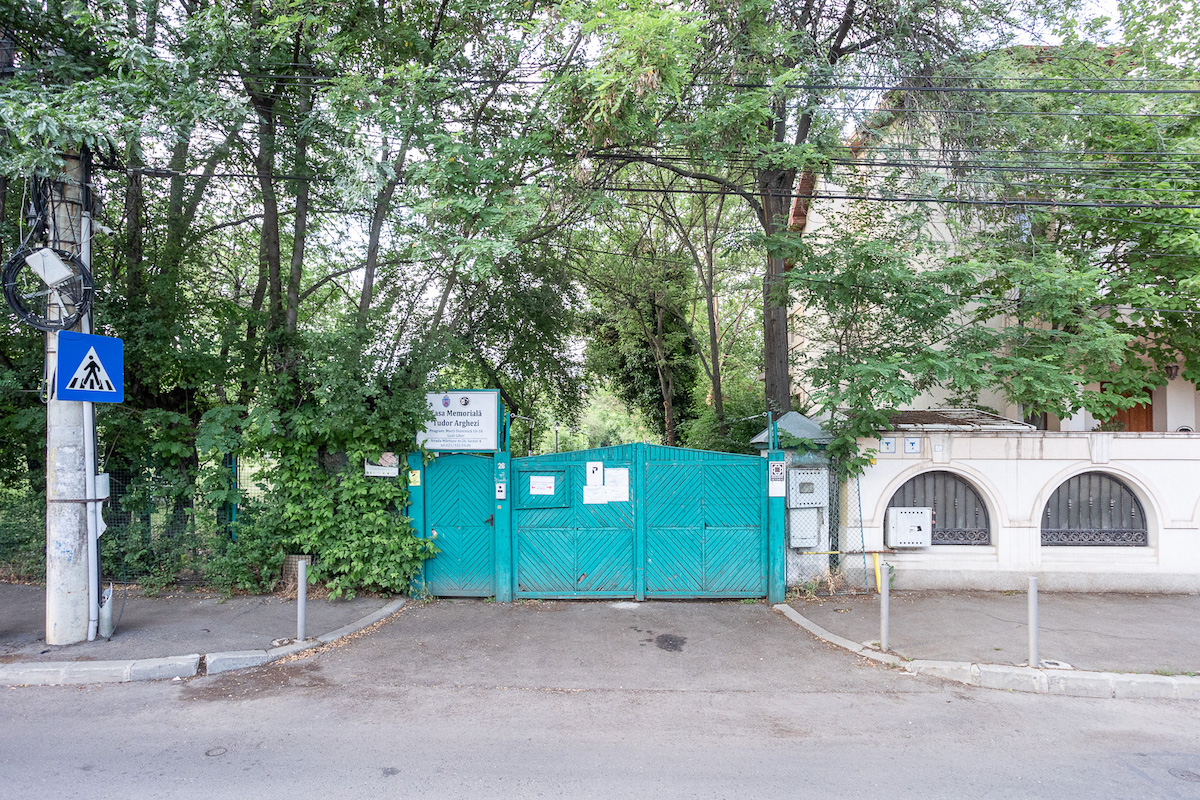
We arrived late at the Tudor Arghezi Memorial House, in a taxi that picked me up from the city center and plunged me straight into Bucharest's 4 p.m. traffic. As we began to climb Mărțișor, I felt the first wave of relief: I had escaped Calea Văcărești, leaving behind the interminable rows of cars and the nervously clenched hands on steering wheels. The second relief came when I stepped through the gate and started moving away from the street along the straight, long, gravel path leading to the house. On my left there were only trees and greenery. Although I had been to the Memorial House three times before, this was the first time I saw the orchard in full leaf. Scents were beginning to take shape; it was May, and without realizing it, I had started to walk more slowly. The gravel path makes your pace slower, I thought, trying to move more briskly. I found Rareș, our photographer, on a bench next to Zdreanță's kennel; he too had effortlessly found a space to take a breather. Dorothea Nicolescu, a curator here for over a decade, was waiting for us inside. We sat down in a small room with an old sofa and armchairs, to the left of the entrance on the ground floor. Dorothea later told us that we were sitting directly beneath Tudor Arghezi's upstairs study.
The ground floor is not open to the public; the house's objects trove is carefully arranged in the upstairs rooms. In addition, the courtyard houses the former space of Arghezi's printing press, Potigrafu'. Dorothea explains that only one volume was actually printed here, Drumul cu povești, although rumors circulate that Bilete de papagal also appeared. Immediately after the publication of the volume — which contains four stories — in 1948, the press was confiscated by the communists.
The annex has become "(…) a space for receiving visitors. Book launches or various events are organized there. We run workshops with children, shadow plays, we screen short films for them." The place has a special charm. Around several vintage printing presses and a few heavy drawers with lead letters brought in to recreate the atmosphere — all gathered in the middle of the room — photographs, illustrations, and other works are periodically displayed along the low walls. Over the past year I caught two such exhibitions: a collection of illustrations (1915-1916) by Francisc Șirato, Arghezi's collaborator at the journal Cronica, and a selection of family photographs from the MNLR archives.
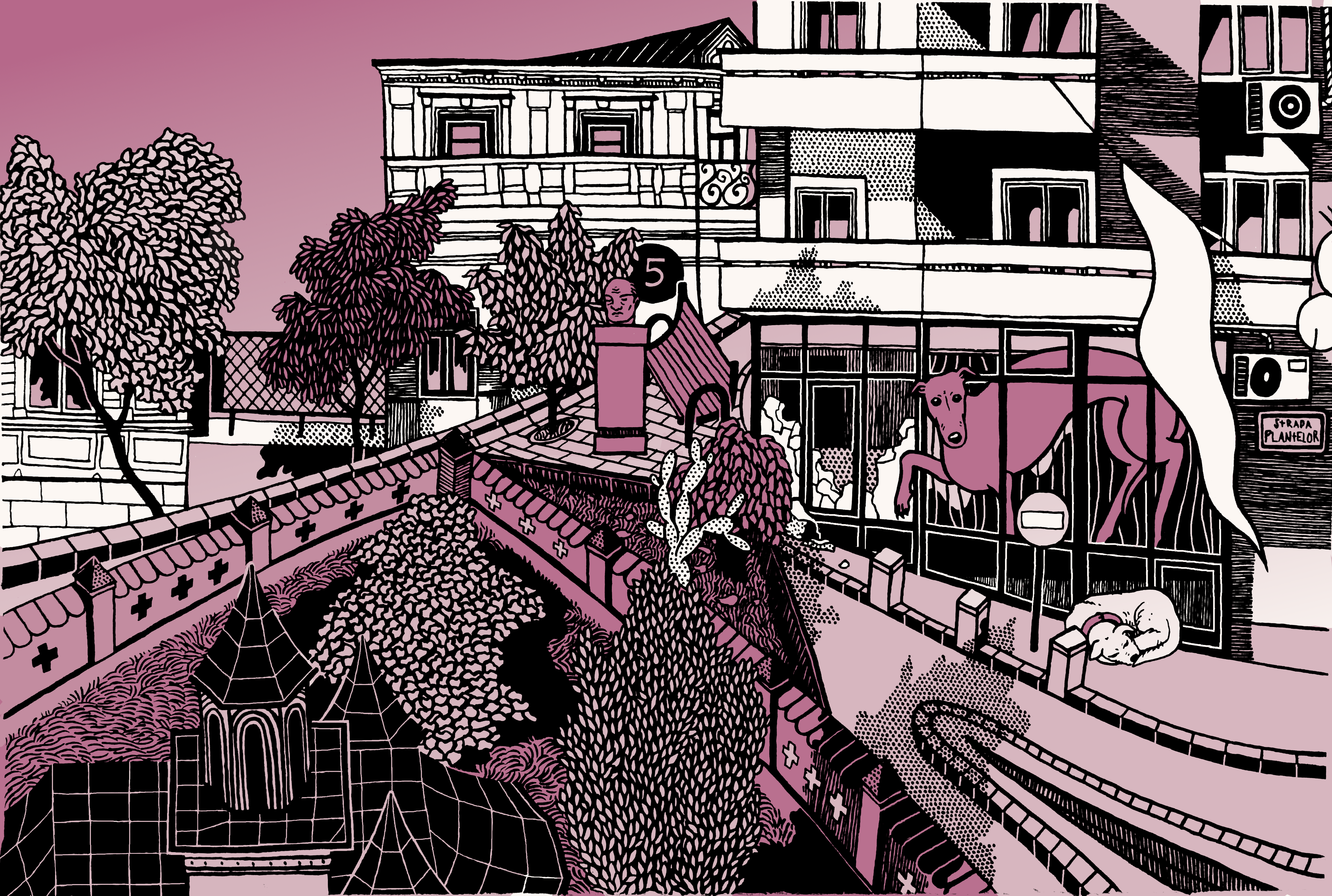
Among the family photographs, at least two stayed with me: one of the Arghezis bundled up on the hill, holding their skis beside them, and another showing the surroundings of the house — nothing but vegetation. Both were taken before the 1960s and speak of a vanished world: skiing is no longer possible on Piscului Hill (formerly Mărțișor), and the view around the memorial house is now cluttered. Apartment blocks have risen along Olteniței, a mall has taken the place of the former Văcărești Monastery, and villas have sprung up that hardly match the profile of this old Bucharest street. In earlier photos, "there were no apartment buildings to be seen. Now they're in the frame. At one point, I even thought of somehow cutting them out in Photoshop. They completely ruined the charm. (…) That was my impulse — to paste over them so the horizon would show, beautiful and green," Dorothea tells us.
The house's relationship with the surrounding view is fundamental. The two turrets Arghezi wanted were designed precisely to open onto a panorama of Bucharest and the horizon line. For safety reasons, these two vantage points are no longer accessible to visitors. They are now administrative spaces, like the attic and the wooden balcony painted red. When we went upstairs to visit the rooms, Dorothea also gave us a tour of the views accesible from different parts of the house: "Among the administrative spaces, the turrets are the most special. From there you also step out onto the roof if repairs are needed or something has to be checked. The balcony stretches along the entire length of the bedroom — you can see it from outside, next to Zdreanță's kennel. It has many windows. The atmosphere there is pleasant, and you get a clear view of the entire orchard. But even here, from the 'hall of medals,' as we call it, you just look out the window and see the whole orchard in front. And that's also a beautiful view." I was able to sneak a glance into the balcony closed to the public for about a minute: the air was warm, and the orchard lay spread out in the sun beneath us. I spotted a woodpecker in the tree in front. Dorothea told us that the Arghezi family used to keep their Christmas tree here.
We moved slowly through the rooms and their little treasures, letting our gaze fall wherever it pleased. The past came alive under Dorothea's words, which in turn animated the household objects, the model house in the back, the stairs leading to the attic, the children's room, the paintings owned by Arghezi, and so on. Among the latter is also a mysterious anonymous work, displayed in the hallway.
A world frozen in time can captivate much like a steam locomotive or a spear once used by Homo neanderthalensis: something from the past has reached us, brings us information, and fills us with wonder. Bucharest's memorial houses, including that of "Tudor Arghezi," have not spanned centuries, but they carry a kind of message in a bottle. Yet the bottle still needs to be opened.
At times we behave as if we are "taking inventory" when our gaze lingers on the finish of the furniture, the details of the fabrics, the yellowed books. The objects remain distant, under a kind of opaque mirage. We might, at most, snap a picture for our social media feed. Yet there is another way of looking — one in which you try to read in the artifacts before you the signs of the times they come from. Then, from being a mere observer, your gaze becomes hermeneutic, interpretive. A museum, a memorial house can be spaces for exercising the art of interpretation, and the guidance of curators is of great help in this respect. Dorothea showed us, for example, that Arghezi's library contains books on how to raise bees, goats, how to make wine, and so on. How can we interpret this, what does it reveal? "If you didn't have the internet and you were curious, if you wanted to learn different things, you had to look them up in books," she said. I added my own thought: that these titles attest to Arghezi's DIY spirit. The hypotheses could go on.
We spoke with Dorothea Nicolescu about the memorial house's visitors and their interaction with the past sheltered in its rooms: "In terms of interest, we could divide the public into two. Some come with their families, out of curiosity, and others come with their schools — meaning teachers bring them, and that's a very good thing. Among the latter, especially the older students, you can see they don't have much patience or enthusiasm. But generally, once they're here, they're surprised, and I'd say they leave satisfied. Especially if they also take part in an activity — all the better, they have a little more time to grow fond of the place. Or if they stay to listen to the stories. In any case, even the children are surprised, and I think for them it feels like a journey through time. The fact that the house is old, that all the objects are original and old, that they see the stoves and carved furniture and paintings, even the smell — it stirs something in them. A curiosity about how things used to be, what life was like before. One child told me it smelled of the past. 'Guys, do you feel that? It smells of the past.'"
Beyond the perceptible presence of the past, there is also a great deal of present at the "Tudor Arghezi" house. Book launches, exhibitions, workshops, concerts, recycling activities, and more are organized regularly. Many of these take place around the house, in the printing press, or in the orchard. The house and its turrets remain fixed, anchored in the past, while the grounds serve as a space dedicated to the present. Dorothea has devised a wealth of additional activities for visitors, especially for children or school groups: "If someone wants a guided visit, it costs 20 lei. An additional activity costs 7 lei. I think it's worth it. It could be a workshop — reading, crafting, seeing a shadow play, making bow ties for a mannequin of Arghezi and posing with it. Anyway, I've done many things over the years. I've been in charge of this area, of museum education activities for children, and I've always come up with something new." The curator and our host feels privileged to work at the memorial house: "This way I've come to know Arghezi much better. I love this place."
School groups from across the country visit regularly. In recent years, the relationship with the neighborhood community has also been strengthened. Since the summer of 2021, the orchard behind the house has hosted a community garden. The project, "The Mărțișor Community Orchard," was launched by a civic initiative group, Acțiunea Comunitară Tineretului (ACT), in partnership with the MNLR. "The project's initiator set up some compost bins here and created a group with people from the neighborhood; they come and bring their vegetable scraps to be turned into compost. Or they organize various activities with an ecological focus. With children, with schools from the area, with families. On such occasions, local residents come by. Many say things like, 'You know, I've been living here for 10 years. Or 20 years. And only now have I come. I haven't been here since I was a kid, when I came with the school, even though I live just one stop away.' It happens."
After the intense memorial tour on the upper floor of the house, the orchard space opens up like an oasis. "When it comes to wild animals and birds, I was surprised when I first came here. I grew up in Bucharest and hadn't really seen many animals or birds. I didn't know what a magpie looked like, or a blackbird, or a starling. But here I learned — there are so many. I've even seen pheasants, for example. One year, when there really was no money and the grass wasn't cut in time, it grew taller and pheasants came. I've seen squirrels here in the yard; and insects too, ones I had never seen before."
Given the scale of the property, maintaining the house and orchard is neither simple nor cheap. Among the five memorial houses managed in Bucharest by the MNLR, "Tudor Arghezi" is, in fact, the most expensive. "We're constantly making lists. We report the issues, and decisions are made depending on the budget — what can be done, what the priorities are, what is most urgent. And depending on the budget, things are resolved along the way." The administration of the house falls under the responsibility of the National Museum of Romanian Literature, and the budget allocated comes from the Bucharest City Hall. "What the museum can do with the budget it receives is at the subsistence level for the houses. Not just ours, but in general, for the museum and the other memorial houses as well. It's no one's fault. That's just the budget for culture. (…) Now, if you ask what will happen in 50 years, whether the house will still stand in 50 or 100 years, with the current level of funding, I don't think it will. There are important things that need to be done, and the money can't be found for them. (…) Everything degrades over time. Still, if there were more funds to invest, things would probably degrade more slowly." To Dorothea's concern, I would add my own — regarding irresponsible and amnesiac urban development.
Storm clouds were gathering above the orchard on Mărțișor. We stepped out of the former printing press and glanced into the curator's office-studio. We were irreversibly charmed by the props she had created for the shadow plays inspired by Arghezi's stories and beyond. Then we said a warm goodbye. Dorothea was heading toward the tram stop along one of the "secret" paths that still cut across the hill. We set off toward the city center. On the way, it began to rain. I walked home on foot, through the warm light that accompanied the streams of rainfall. Images kept returning to me: Arghezi's study, Rousseau's smile, Dorothea's creations. I felt as if I had just come back from an island.