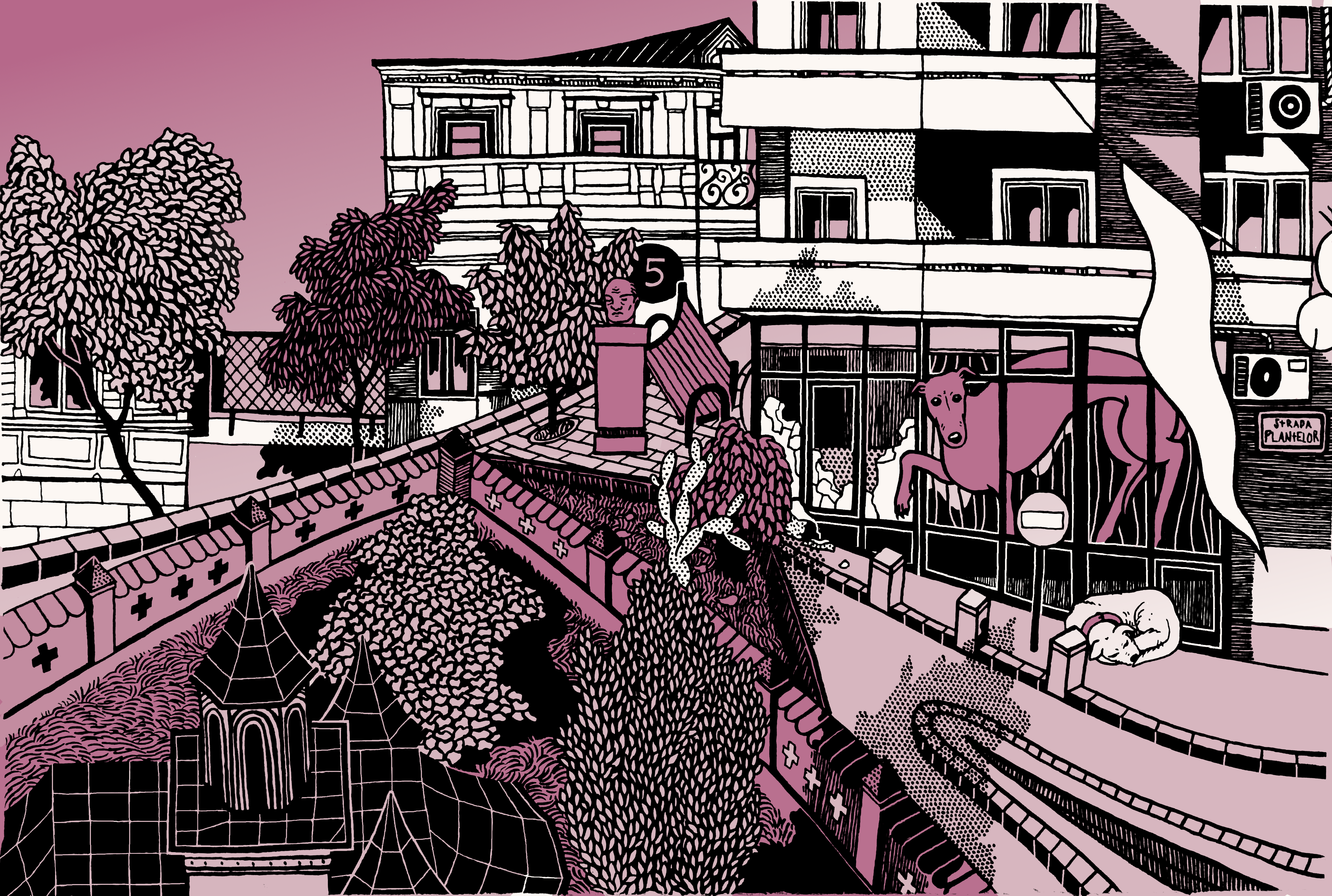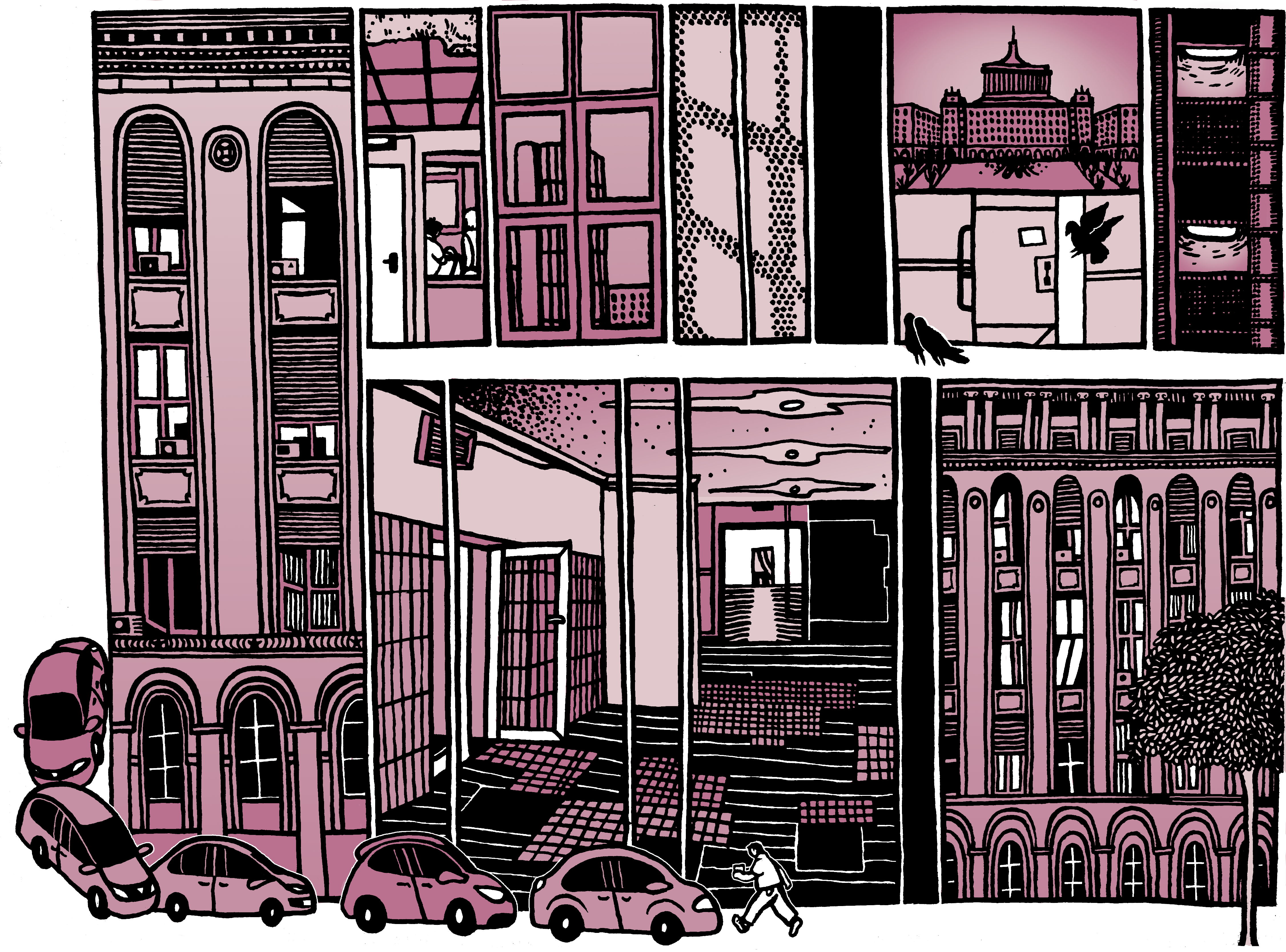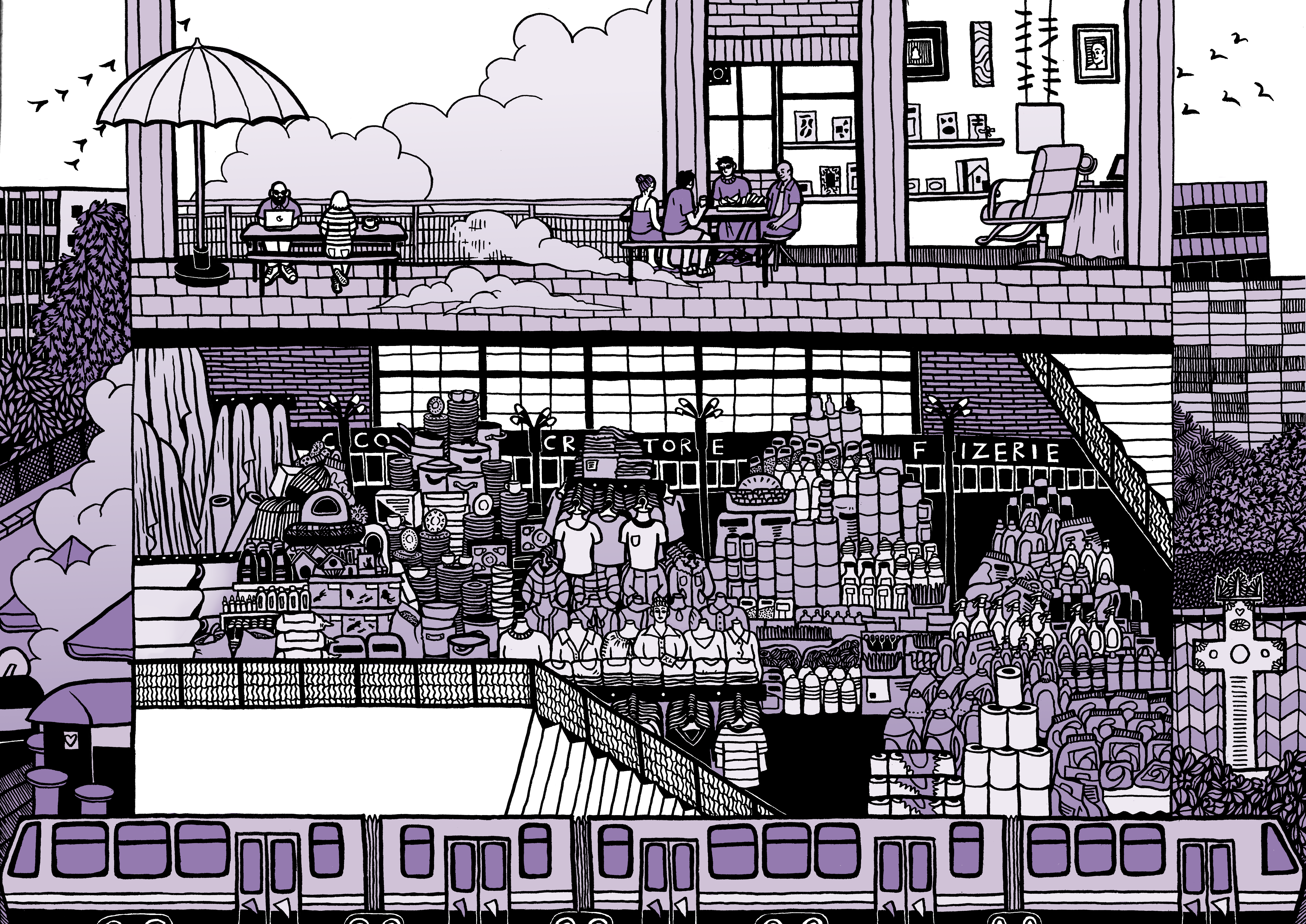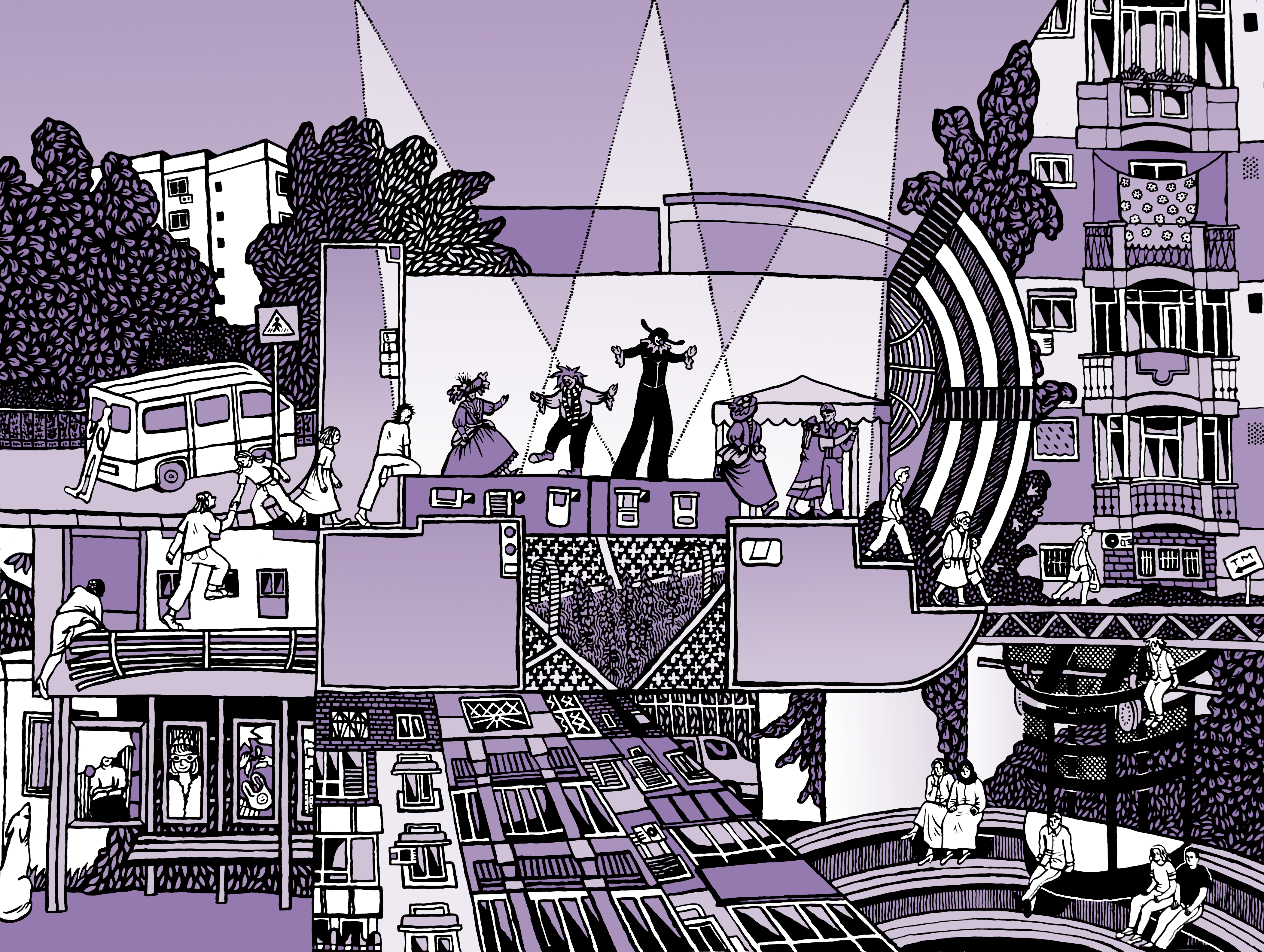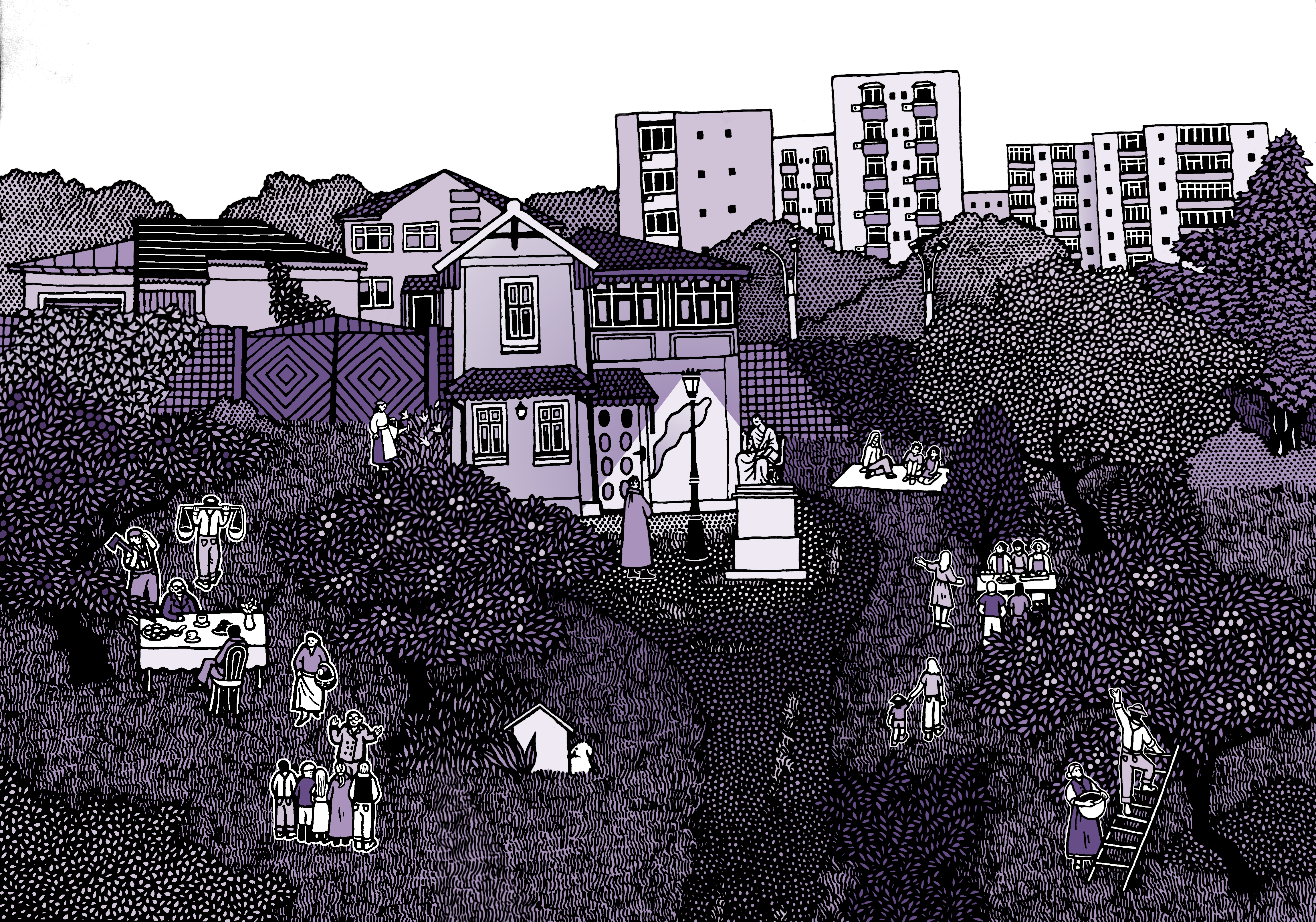
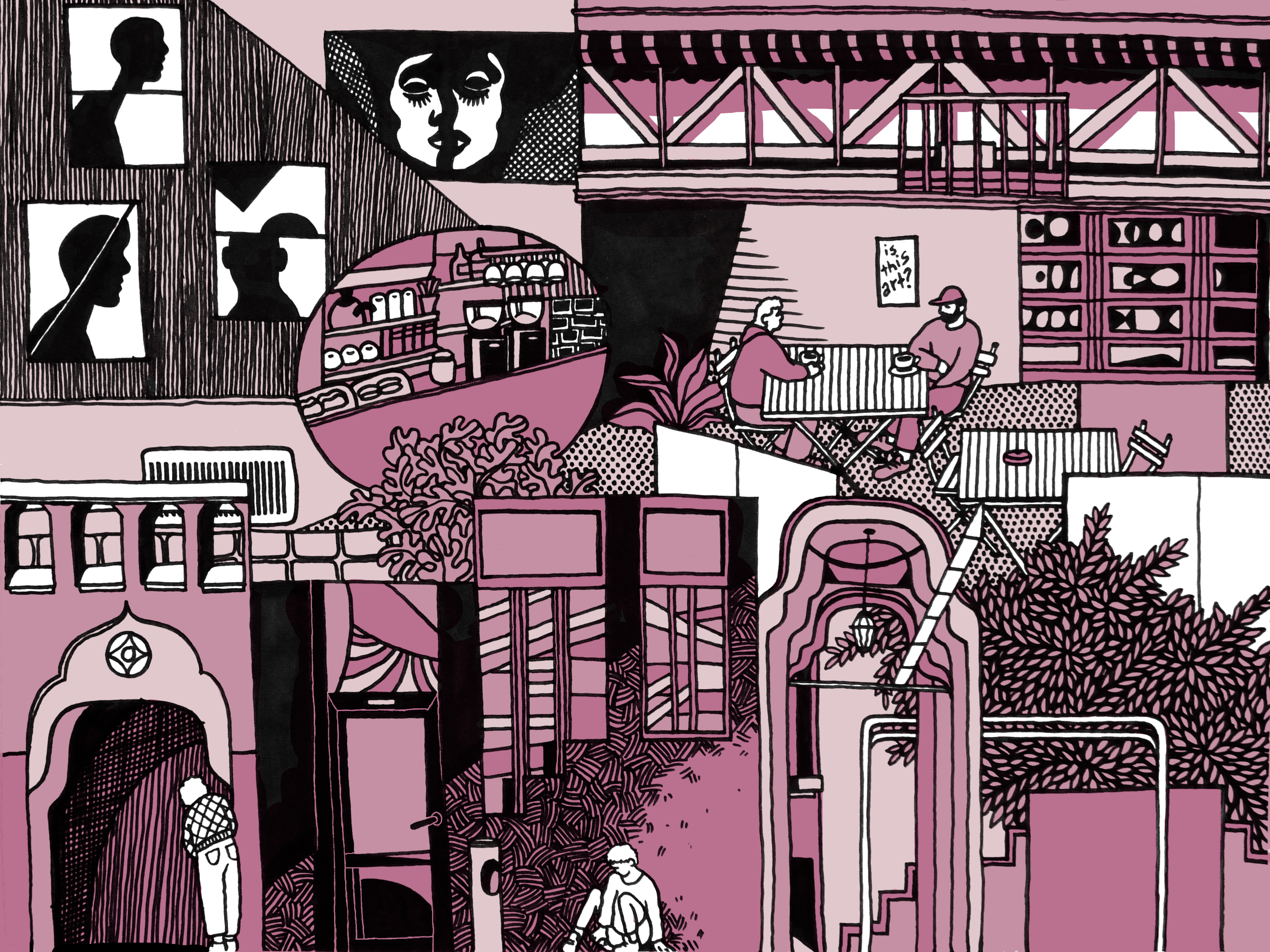
In 2023, the Photography Resource Centre officially opened its doors in a neighbourhood that seems to be undergoing a slow and continuous reconfiguration, both socially and urbanistically. The 19th and 20th century urban fabric has recently been upgraded with collective housing, but there are still vacant lots and buildings in an advanced state of decay awaiting rehabilitation.
The CdRF is located near the Gara de Nord Station and the former Matache Macelaru Square, built in 1887, an area which saw a lot of commercial activity among the aristans and craftsman of the time. In 1948, the market came under state ownership and was renamed to Ilie Pintilie Market. Sixty-five years later, the neighbourhood witnessed the loss of the Hala Matache building. In 2013, under the mandate of former mayor Sorin Oprescu, one of the buildings that formed the core of the capital's identity was abusively demolished overnight. At the same time, dozens of other historical monuments were razed to the ground, with all the necessary permits except that of the Ministry of Culture. The purpose of the demolition? The construction of the North-South Diametraleia, on the Buzesti - Berzei - Uranus axis, an urban infrastructure project to improve traffic flow which destroyed an important historical segment of the city. This case is well documented by the Platforma Matache project, which collected testimonies and articles and produced a valuable documentary on the entire demolition process and its consequences.
Although it is currently a predominantly residential area, in recent years various spaces have emerged that bring together those interested in culture and involved in the social life of the city. Recently, two photo development centres opened in the area, ISO 400 and Camera Lucida, and not long ago the Dispozitiv Books library operated at Popa Tatu 20. In the spring of 2023, work began on the Grivita Theater, which will open its doors to the public in the coming years.
The land on which CdRF is built was purchased in 2011, at a time when buildings in the Matache area were still being sold at low prices because of the bad reputation that loomed over the neighbourhood. "Except for the fact that we would find syringes on the ground at night, everything else was fine," Andreea recalls. For them, the neighbourhood's bad reputation was not an obstacle, and they knew that once you settle in there you become part of the community.
The CdRF is located in the protected area no. 44 - Temisana, a street where there is a listed building, the so-called Venetian Palace, at numbers 2-4. Obtaining permits in protected areas is always more difficult, requiring thorough documentation and approvals from various institutions, including the Ministry of Culture. "We made friends with the local police and the ISC (The State Inspector in Constructions)," says Alex, who was in charge of the file. "I was just the innocent taxpayer who went with the pile of files." He says the people weren't exactly malicious, but being part of a cumbersome mechanism that starts with a presumption of guilt makes them act that way. "They thought I was trying to trick them by saying I was going to build a ground floor with a loft, when in fact I was going to do something completely different."
The process took quite a long time, especially if we take into account the duration of the construction process. However, the length of time has also been an advantage, as it has allowed the CdRF team to deepen and refine the ideas they are taking on the road. "We have a privilege that we understand. A place of calm and a firm ground. We have dreams, but we are not yet ready to say them publicly."
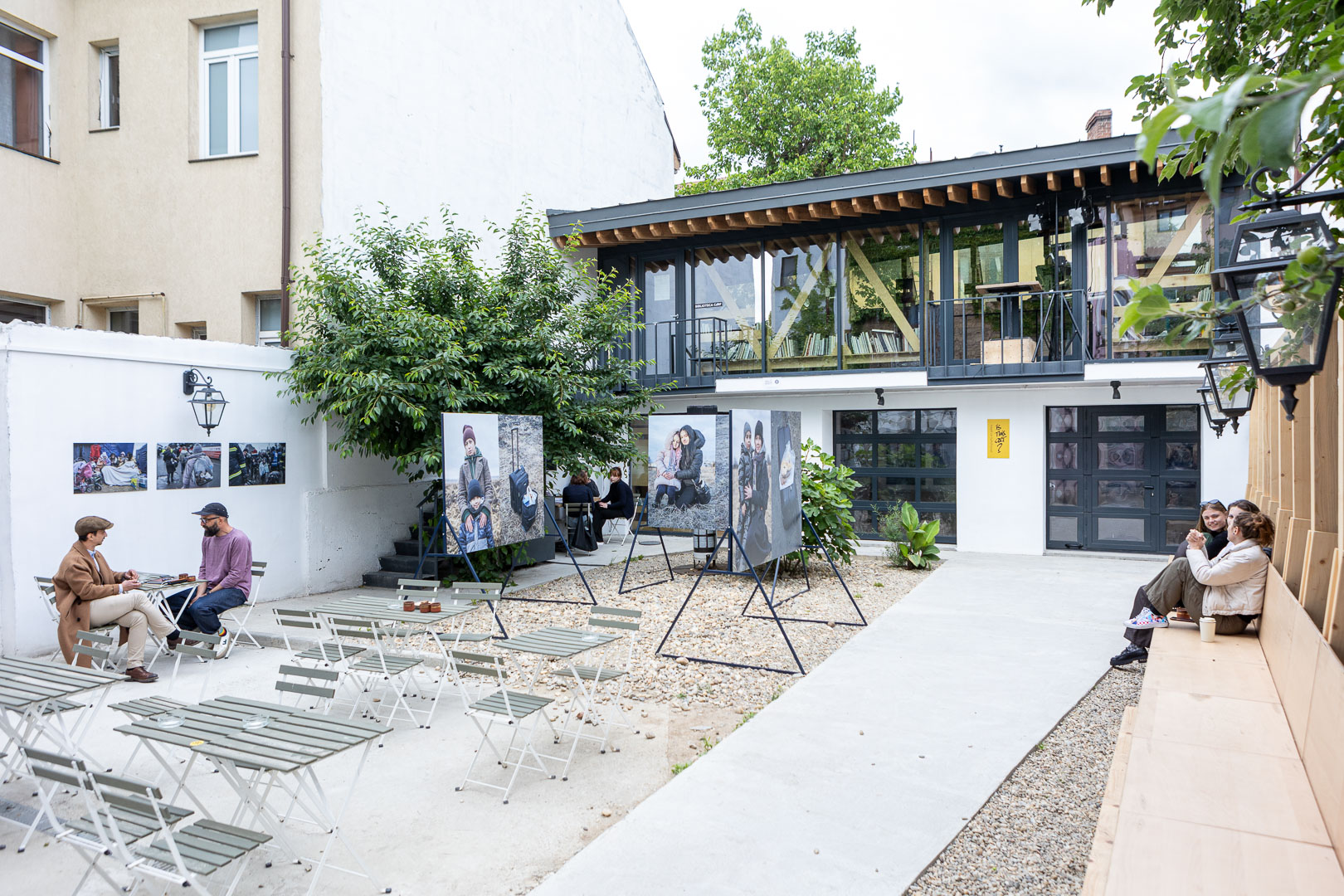
The CdRF headquarters, designed by the architects at BAAB, has three main spaces: an attic (30m2) and two rooms on the ground floor (50m2) - one for the gallery and the other for the cafe, connected and at the same time separated by a concrete wall in which a large circular hole has been cut.
In the 1950s, three garages were built behind the courtyard. "The official project was to raise these outbuildings [the garages] and repair the foundations and cellars," said Irina, whom we met on a sunny morning in the courtyard of the CdRF.
The challenge for BAAB was considerable: to transform former garages into a cultural building while respecting the urban context. The result is an "architectural object" that is as much compact as it is full of details that only become apparent after a third or fourth visit. Many of the architectural solutions were born spontaneously at the beginning of the construction, showing a great openness and sensitivity to the site. What remains of the former garages is the footprint and the cellar, hidden by a trap door, just below the cafe.
As a reference to the former buildings in the courtyard and to the specificity of Bucharest, a city of overlapping layers and reconversions, the space at the ground floor is still closed with rolling doors. Another clin d'oeil (another nod) to the former building is the massive concrete structure of the ground floor. It is unfinished and has a rougher appearance. Because it is built on three connecting walls, the architects used an experimental, environmentally friendly material for the infill: hempcrete, or "straw concrete," as Irina calls it. Unlike brick, for example, it is both thin and thermally insulating. The CdRF gallery is therefore a space wrapped in a "concrete shell" into which one descends. The feeling I had on my first visit was that of an abstract space in which the photographs on display seem to emerge from the wall.
When I climbed to the attic on the outside metal staircase, the atmosphere changed completely. Instead of pure concrete and asbestos, I landed in a kind of cocoon of light, mostly made of wood, metal and glass. The sensory experience was different. In the floor we discovered a porthole that allowed us to "spy" what was going on below. In fact, the attic communicates with all the spaces around it: you can see both the inner courtyard of the centre and the vegetation in the neighbours' yard, typical of old Bucharest (fruit trees).
We won't reveal all the surprises we had while exploring the building on Popa Tatu, but we will say that somewhere there is a wonderful square, and somewhere else there is a walkway.
Popa Tatu is a "bridge-street" for cars to cross quickly and efficiently from the centre to the railway station. Yet, no matter the traffic at the street level, the courtyard remains quiet. On weekends it's full of kids. It's a safe and friendly place that has already attracted a small community of neighbours who come to drink their coffee there.
The entrance to this tranquil oasis is through a gangway that starts from the street. Usually, gangways used to be seen as dark and spooky places where children played and scared each other. Yet, the CdRF gangway does not fit into these urban typologies, though, as it used to be a private driveway for cars to the backyard garages. What's interesting, Irina made us realize, is that none of today's cars are slim enough to drive through the gangway and park in the backyard garage. Car sizes have increased significantly since the 1950s.
The gangway has a high ceiling and functions as an intermediate space between two urban paradigms: the street - public and noisy, and the courtyard - intimate and quiet. It's the gangway that announces there's more going on once you walk through it: "Passers-by first saw that something was going on in the gangway and saw the banners on the fence, and then they went in to see what's here," Andreea tells us.
This space was conceived with a different purpose than the main exhibition space of the gallery, and is dedicated to photographers at the beginning of their careers. Despite being an unconventional exhibition space, the gangway enjoys a high visibility due to the curious people who want to explore the courtyard, even if not all make it all the way to the gallery.
"The gangway is supposed to be that space where we say, 'Okay, you want to exhibit? Go exhibit. We'll help you conceptualize," says Andreea. The specificity of the gangway consists in the fact that it's open to people who come from outside with the desire to exhibit there, while the gallery space is dedicated to internally curated projects. "In the gallery we display the photographic projects that we represent. There we deal with production, communication, everything", she explains.
I asked if they ever happened to collaborate with someone who discovered CdRF by chance, noticed the gangway, and was curious about what was at the end of it. "I don't think proximity alone was ever enough for such collaborations. People generally expect to pay for exhibition space. That's not the case with us, so what you see in the courtyard and the gang is free of charge".
There are exceptions, however, when the outdoor space continues the gallery space and is used for internal exhibitions. When we met Alex, Andreea and Ion, CdRF's courtyard and gallery were hosting two photography exhibitions - Broken Borders si Seamless. Both projects were based on the idea of bringing together a foreign curator and a Romanian artist. For the outdoor spaces, the gangway and the courtyard, the match was between Ioana Moldovan and the curator Arianna Rinaldo, and for the gallery, the match was between Andrei Pacuraru and Natan Dvir (some details about the two exhibitions here).
Not a single one of the three founding members of the CdRF claims the title "photographer." Rather, the CdRF team talks about mediating, putting together, bringing together.
Once the project received funding, Andreea and Ion decided to enliven the Popa Tatu space by organizing as many events as possible. It's a model they successfully implemented in Mangalia, as part of the Callatis Cultural Garden project. There, as consultants, they advised the staff of the Ministry of Culture and Sports to focus on micro-events and diversity to bring the Callatis Garden to life and highlight local artists. "We try to do the same thing here [at CdRF]. We have many events, many small ones, just to activate the space in some way, so that people understand that they can come here, that things are happening, that you are welcome," Ion told us, and Alex followed up by listing the kind of events that the Popa Tatu space hosts: "(...) there are not just photos on the walls, but there are also artist talks, music, we will also have some performances".
Talking to our hosts about the motivation behind CdRF, we learned that the team's initial goal was simple: education. "Education was and still is our credo. I ask the students why is it that this ad attracts them and appeals to them and another one doesn't? (...) Why in this newspaper this meeting is portrayed in a certain way, but in the other newspaper you have the impression that it's a completely different meeting? Why do I sometimes stop when I'm on Instagram? (...) Why do I stop at this picture? Very few people can tell you why. (...) We have many photography courses, including college and private. But we lack visual education. We don't really learn visual education in school, everyone makes fun of it and ignores the subject. In the Visual Education class we do mathematics, we discuss administrative matters, but visual education is also very important" (Andreea). Presently, paid photography courses are held in the centre's attic, and there is also a library with free access, where you can consult more than 400 specialized titles (books, magazines and albums). The light is very pleasant and it's quiet.
In addition to the courses on photography and on how to decode the images around us, CdRF also wants to contribute to changing the way photography is perceived in the Romanian space. According to Andrea, "in the perception of the public, the state and also of many photographers, photography is linked to a job or to Instagram. It's not linked to an artistic product. We don't think it could have a real value, or that its value could increase over time. But it (this perception) will eventually take root, and that's what we want to instil, one step at a time."
Coming back to education, despite the fact that photography is studied in the country's art universities, in the eyes of the general public it remains more of a hobby, according to Andreea. In her and Ion's opinion, there are many aspects that have led to this situation: the historical gap with Western countries and the lack of self-confidence of talented photographers in our country; the still low financial access to high-performance equipment; the lack of public funding for photography - compared to film; the democratization of photography and the widespread impression that anyone can "take pictures" without special training; and, last but not least, the prejudices against humanities studies and the many diploma mills in the private sector. On the axis hobby/art product - photography can occupy many positions, and the CdRF hopes to better consolidate the artistic segment and the perception of photography as a carrier of rhetorical power that can convey a certain type of message to a certain audience.
I resonated with the CdRF team's view of education. A minimum of artistic culture is absolutely necessary for every individual, and perhaps even more so for society as a whole. But at present, de facto, in the country's pre-university education, in the non-vocational profiles, there are only two artistic subjects: Drawing and Music. We all know the numerous and unfortunate prejudices against art and music education. The "geeks" who like these subjects, sometimes even more than those labelled as "serious" or "profitable," are often mocked. "It's exactly the same as when people ask you 'What's wrong with you, are you a loser, why are you studying humanities?'. It's a cultural custom of ours," Andreea says. Just as people in high school laugh at those who study the humanities, employers in the private sector smile disapprovingly at the humanities degrees of prospective employees, labelling them "overqualified"; in other words, useless.
In 2020, Sibi-Bogdan Teodorescu, an artist and visual education teacher in Bucharest, reacted to the Ministry of Education's proposal that year to make Visual Education and Music Education optional subjects - in other words, to nudge them to the side-lines. There is also a long-running debate in academia about "the crisis of humanities education". Recently, the UBB launched a Humanist Platform to respond to the fact that "the sciences concerned with human knowledge and the common good are overshadowed by the sciences devoted to nature/technology." In response, the journal VATRA published in April 2024 a dossier devoted to the humanities and the history of their drift into the shadows; the article by Marius Lazar provides a good sociological contextualization of the current situation.
In other words, the lack of visual literacy we discussed with CdRF members has a complex and troubling underlying cause.
To the left of the gallery, on the ground floor of the CdRF, there is a cafe with a few tables scattered in the courtyard beyond the gangway. But the space on Popa Tatu is designed to be a gallery first and foremost: "We're not a cafe, we're a gallery where you can drink coffee. That's pretty much the order of things," Alex explains. But this order is challenged by the organic development of the cafe and the small garden: "Even if we didn't think about it consciously from the beginning, we see the space here turning into a third space", Andreea told us at another point in our conversation. Students "come in, take a book, have a soda or ask for a glass of water and hang out for hours. (...) Last summer it was full of young people who had night flights and waited here, sometimes sleeping on their luggage in the courtyard."
In short, a third space is a friendly place where commercialism is kept to a minimum and where you feel safe. The term has a rich history (see end of text). The most accessible meaning of third space is that proposed by sociologist Ray Oldenburg. In 1989, he published The Great Good Places, a book in which he sharply criticized the lack of public and informal spaces in the suburbs of major US cities and tried to convince his readers of the enormous benefits that such spaces would bring if they were included in urban planning.
For the author, the "first space" is the home, the second is the workplace, and the "third space" is simply the informal place where people gather, talk freely, get to know each other, and interact freely. It is not just the place where we "escape," it is constitutive of who we are and of community. Examples of tertiary spaces in the European urban environment are squares, the stairs of a public institution, certain neighbourhood bars and cafes with a non-consumerist atmosphere, etc.
Essential to a "third space" is its neutrality: social and age differences no longer matter. What's more, strangers are welcome. Although there are local regulars and a certain initiation ritual to fit in, there is a native openness to difference in these places. Interaction is free of any purpose or obligation, conversation is for its own sake, for the pleasure of being together. Because of this, there are often moments of cohesion that the participants want to repeat, to the point where the place becomes a "second home". Tertiary spaces are unpretentious places, they don't stand out. After all, Oldenburg believed that without a third space, there would be little community or real neighbourly relations, and that the inhabitants would syssifically spin in the metro-boulot-dodo (metro-office-sleep) wheel.
The CdRF's interests may not overlap perfectly with Oldenburg's, but a need for "pure sociability" seems to hover over Bucharest's urban space. The courtyard of the CdRF shows signs of becoming such a third space.
I've written more about the concept of "third space" here.
The concept of "third space" predates Oldenburg's 1989 book. I will briefly refer to two of its earlier episodes. The first takes place in 1974, in the work "La production de l'espace," by the leftist philosopher and sociologist Henri Lefebvre, probably the father of the concept, though not the one who coined the term "third space." Lefebvre writes a tonic, subversive work in the wake of May '68, arguing that space can no longer be understood as a neutral backdrop against which human beings carry out their existence, but that we need very detailed analyses of how space is produced, especially by those who hold political power and the planners and architects who support them, and of how, in turn, it produces certain experiences and symbolic meanings.
In every European city, each of us is involved in a "spatial practice" that we have not chosen, but in which we are forced to live (Lefebvre's emphasis often falls on the corporeal dimension of this living). One of the author's theses is that urban space tends to be reduced to the rhythm of work, to transportation and routes, to abstract schemes and plans. The dominant economic model produces "abstract spaces" instead of living cities. The urban is fragmented into specialized spaces, saturated with advertising and commodities, crisscrossed by economic forces that produce segregation and social discrimination (there is much talk these days of ghettos created by the choices of the agents who organize urban space). For Lefebvre, abstraction leads to alienation, to the emptying of meaning from everyday life.
This tendency toward top-down abstraction can be countered by what Lefebvre calls lived spaces. What are they? The author describes three moments of spatiality: perceived, conceived and lived space (espace percu, espace concu, espace vecu). They capture three attitudes in which we always situate ourselves: the one in which we use the spatial configuration of a city to carry out our activities. In the case of modern cities, this is the network of roads, public transportation, headquarters, residences, leisure spaces - everything that makes up the material dimension of a society and its "spatial practice." The second attitude corresponds to a mental approach to space, as a result of which we produce theories, maps, plans, and so on. Think of how space is conceived in physics, geometry, architecture, urban planning, classical geography, etc. The dominant figure in these mental approaches is the plane, the 2D representation. Finally, the third dimension, or approach to spatiality, is based on interaction (long-term or very intense) and involves giving certain places certain meanings.
The latter, the "lived space," is what will later become the "third space." It differs from the perceived and the conceived space mainly in its affective emphasis: the lived space is the one we construct in our personal narratives and, collectively, in those of history. It may be the parking lot where we played hide-and-seek as children, the cafe where artists meet and plot revolutions, your favourite corner of the house, or a certain ancient square.
There is now research on "affective/mental geography", but Lefebvre sees more in terms of the lived dimension of the city. For him, the third space is where an appropriation of the flattened and instrumental urban space takes place. Through appropriation, meanings emerge that are liberated from the logic of needs, pleasure and gratuitousness appear, and differences are no longer systematized and thus standardized. By its very nature, the appropriation of a place inevitably opposes the domination exercised by political and economic actors (p. 450). Sometimes this opposition is overt, as when a community gathers to block the construction of a highway or to defend green spaces and demand their expansion. People gathered on the steps of an institution in the evening or at noon give that place a symbolic power that defends the city from dismemberment and limits the rise of the private sector.
The second episode in the history of third space takes place in the work of Lefebvre's student, Edward Soja, an urban planner and geographer who is an avowed postmodernist. In a work published in 1996, he takes up and develops the notion of "lived space". For Soja, the third space, the "lived social space", is first and foremost a space of radical openness to otherness. The great theoretical merit of Lefebvre's work, in Soja's eyes, is the overcoming of the binary logic of spatiality (p. 53). "There will always be an Other", says the French author. Any opposition (centre-periphery, developed-underdeveloped, local-global, us-them, etc.) and the inhospitable system of otherness it generates can be challenged through a process Soja calls "thirding" (pp. 60-61). Thus, any third space has an immense potential for protest, resistance, and social cohesion, since it is born precisely to stand against the binary.
In fact, although Oldenburg was concerned with the communal benefits of tertiary spaces, he offered several examples in favour of the subversive potential of tertiary spaces. One of them dates back to early 18th-century Sweden, where the monarchy had banned the consumption of coffee. This measure was taken precisely because the informal places where coffee was consumed, the coffeehouses of the time, had become hostile to the regime (p. 83).
Thus, at the end of at least five decades of history, the concept of "third space" refers to an affective dimension, to ownership and resistance to homogenization. A third space is the privileged place of the possible (a possibilities machine, in Soja's words).